
Need Uncompressed Audio for Your Project?
MP3 works great for listening, but audio editing software performs better with uncompressed WAV files. Video editors, podcast producers, and music mixers often need WAV format for reliable timeline behavior and consistent sample rates.
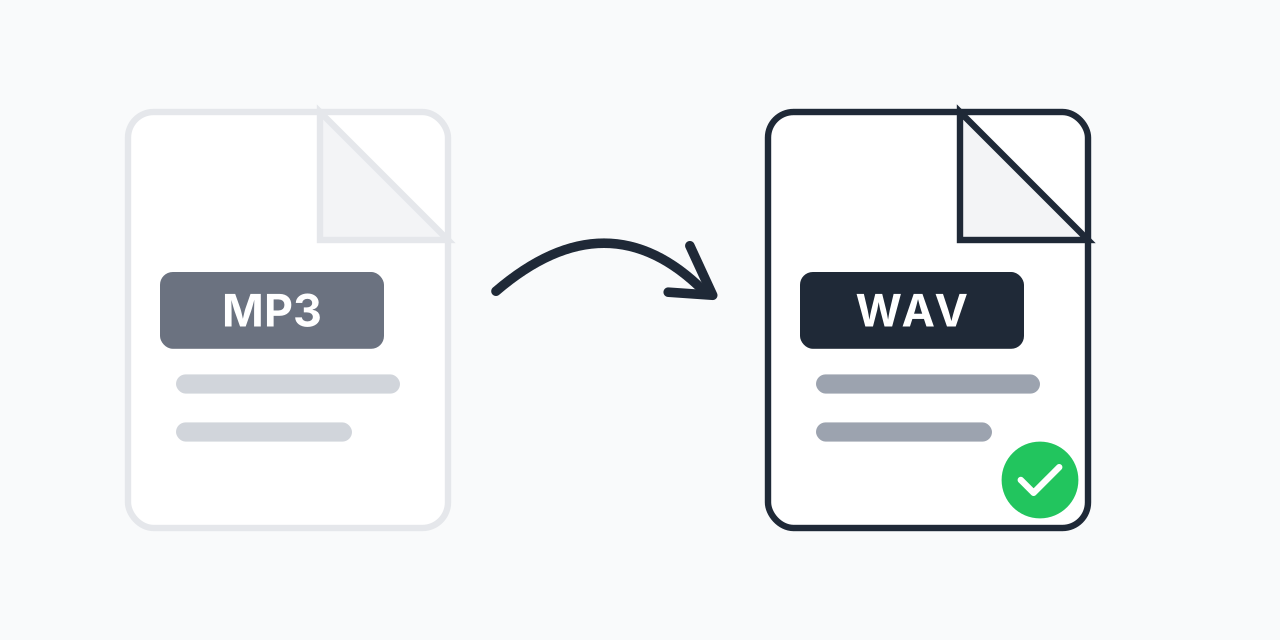
Converting MP3 to WAV expands the compressed audio into an uncompressed waveform that editing software handles smoothly-no stuttering, no sample rate conflicts, no mysterious glitches mid-project.
How to Convert MP3 to WAV
- Upload your MP3 file - Drag and drop or select your compressed audio file
- Confirm WAV output - WAV provides the uncompressed format editors prefer
- Download your file - Get your WAV ready for import into any editing software
The conversion happens in your browser. Your audio stays private, and most files convert in seconds.
What About Quality?
A common misconception: converting MP3 to WAV doesn't improve audio quality. The frequencies MP3 compression removed are gone permanently. What you get is the same audio in an uncompressed container.
However, WAV files don't degrade further during editing. Each time you export an MP3, quality drops slightly. Editing in WAV and exporting to MP3 only once preserves maximum quality.
- For the best quality: Start with lossless sources (FLAC, original WAV, CD)
- For MP3 sources: Convert to WAV for editing, accept the inherent limitations
- Consider MP3 to FLAC: If you need a lossless container for archiving
Understanding MP3 vs WAV
MP3 and WAV serve different purposes in the audio world:
- MP3 - Lossy compression at 128-320 kbps. Small files, some audio data permanently removed
- WAV - Uncompressed PCM audio at 1411 kbps (CD quality). Large files, no data loss
- File size difference - A 5MB MP3 becomes roughly 50MB as WAV
- Quality note - Converting MP3 to WAV doesn't restore lost frequencies, but provides editing compatibility
Think of WAV as the working format and MP3 as the delivery format.
When to Convert MP3 to WAV
Video Editing Projects
Premiere Pro, DaVinci Resolve, and Final Cut handle WAV more reliably than MP3. Professional editors convert all audio to 48kHz WAV before importing-it prevents sync issues and timeline glitches that plague mixed-format projects.
Audio Production and Mixing
DAWs like Audacity, Logic, and Ableton work natively with WAV. While they can import MP3, converting first ensures consistent behavior. Your effects processing and exports will be cleaner.
CD Burning
Audio CDs require uncompressed PCM audio at 44.1kHz. If you're burning a disc from MP3 files, converting to WAV first gives your burning software the format it needs.
Archiving and Backup
WAV files are universally supported and don't depend on specific codecs. For long-term storage of important audio, WAV ensures future compatibility.
Sample Rate Considerations
Sample rate matters when you're working with video:
- 44.1kHz - CD audio standard. Use for music-only projects
- 48kHz - Video standard. Use when audio will sync with video footage
- 96kHz - High-resolution audio for professional mastering
If your MP3 is 44.1kHz and your video project is 48kHz, the conversion can resample to match. Consistent sample rates across all project audio prevents playback issues.
Batch Convert Multiple MP3 Files
Converting a full album or podcast series? Upload multiple MP3 files and convert them all to WAV simultaneously. Consistent output settings ensure your entire project uses matching audio specifications.
Works on Any Device
No software installation needed. Convert MP3 to WAV directly in your browser:
- Windows, Mac, Linux, Chromebook
- Chrome, Firefox, Safari, Edge
- iPhone, iPad, Android devices
Processing happens locally-your audio files remain private throughout the conversion.