Need FLAC Format But Only Have MP3?
Your audio software only accepts FLAC files. Your music player insists on lossless formats. Your workflow requires consistent file extensions across your library. You have MP3 files that need to become FLAC-not for quality reasons, but for practical compatibility.
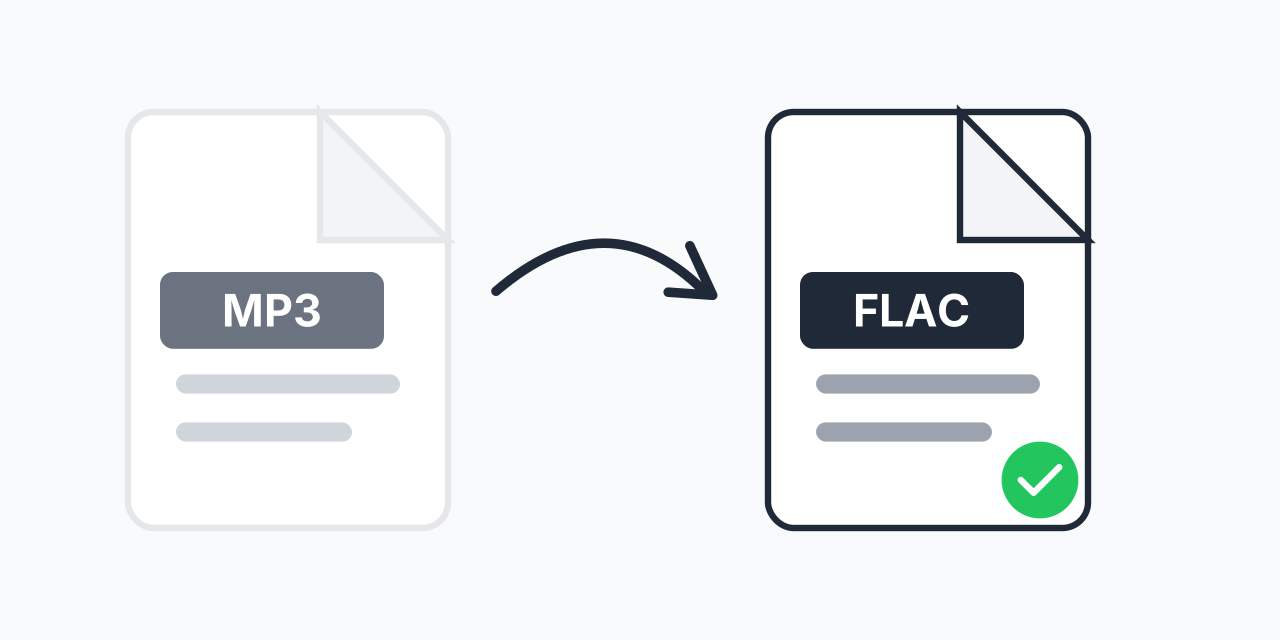
Here's what most converters won't tell you: converting MP3 to FLAC won't improve audio quality. MP3 is a lossy format that already discarded audio data during its original compression. Converting to FLAC preserves what remains in a lossless container, but it cannot restore what MP3 compression removed. However, there are legitimate reasons to make this conversion, and our tool handles it cleanly.
How to Convert MP3 to FLAC
- Upload your MP3 file - Drag and drop or browse to select your MP3 audio files
- Confirm FLAC output - FLAC container selected, your audio will be wrapped in lossless format
- Download your file - Get your FLAC file ready for compatible players and software
Conversion happens in your browser. No software to install, no account required. Your files process locally for speed and privacy.
MP3 vs FLAC: Understanding the Technical Reality
These formats represent fundamentally different approaches to audio storage:
- MP3 bitrate range - 8-320 kbps, typically 128-320 kbps for music
- FLAC bitrate range - 750-1200 kbps, roughly 3-4x larger than MP3 at equivalent content
- MP3 sampling - Up to 48 kHz, 2 channels maximum (stereo)
- FLAC sampling - Up to 655 kHz, 8 channels, 32-bit depth
- Compression type - MP3 uses psychoacoustic modeling (removes data), FLAC uses mathematical compression (preserves all data)
When you convert MP3 to FLAC, your file size increases significantly because FLAC doesn't compress as aggressively. However, the audio information remains exactly what was in the MP3-no better, no worse. Think of it as moving items from a compressed box to a lossless archive container.
When MP3 to FLAC Conversion Actually Makes Sense
FLAC-Only Players and Software
Some audiophile music players and high-end DACs only accept FLAC files. If your device won't play MP3 directly, wrapping the audio in FLAC format gives you compatibility without re-purchasing your music library in true lossless format.
Consistent Library Organization
Managing a mixed library of FLAC and MP3 creates workflow friction. Some users prefer converting everything to FLAC for consistent file handling, even accepting that older MP3 sources won't match true lossless quality. The organizational benefit outweighs the storage cost.
Software Workflow Requirements
Audio editing software, podcast tools, or music production apps sometimes require FLAC input. Converting MP3 to FLAC lets you use these tools without format rejection errors-the editing happens, and you export to your final desired format afterward.
Preparing for Future Editing
If you plan to make minor edits to MP3 audio, converting to FLAC first prevents additional lossy compression. Each time you edit and re-save as MP3, quality degrades. Working in FLAC preserves the current quality level through your editing workflow.
When NOT to Convert MP3 to FLAC
Be honest with yourself about these scenarios:
- Don't convert for quality improvement - FLAC cannot restore audio data that MP3 compression already removed
- Don't convert for audiophile listening - A 320kbps MP3 wrapped in FLAC still sounds like 320kbps MP3, not true lossless audio
- Don't convert for archival purposes - If you want archival quality, source true FLAC from CD rips or lossless streaming
- Consider MP3 to WAV instead - If your software accepts WAV, that's simpler than FLAC for editing workflows
For genuine high-fidelity audio, start with lossless sources. If you're working with FLAC files and need different formats, you'll preserve quality. Converting from MP3 to FLAC is a container change, not a quality upgrade.
File Size Reality Check
Converting MP3 to FLAC increases file size without adding audio information:
- 3-minute 320kbps MP3 - Approximately 7 MB
- Same audio as FLAC - Approximately 25-30 MB (3-4x larger)
- True CD-quality FLAC - Approximately 28-35 MB
Your converted FLAC file will approach the size of true lossless audio but contain the same audio data as the original MP3. Factor in storage costs when converting large libraries.
Alternative Conversions from MP3
Depending on your actual need, consider these alternatives:
- MP3 to WAV - Better for video editing software that prefers uncompressed audio
- MP3 to AAC - Slightly better compression if targeting Apple devices
- MP3 to OGG - Open-source alternative with similar quality at smaller size
- All MP3 conversions - See all available output formats from MP3
Batch Convert Multiple MP3 Files
Converting an entire music collection? Upload multiple MP3 files at once. Each file converts independently to FLAC format, maintaining consistent output. Download all your FLAC files together-ideal for standardizing large audio libraries.
Works on Any Device
Our browser-based converter runs on any modern device:
- Windows, Mac, Linux, Chromebook
- Chrome, Firefox, Safari, Edge
- iPhone, iPad, Android tablets and phones
No software installation required. Convert MP3 to FLAC wherever you have a browser and an internet connection.