Free Online Audio Converter
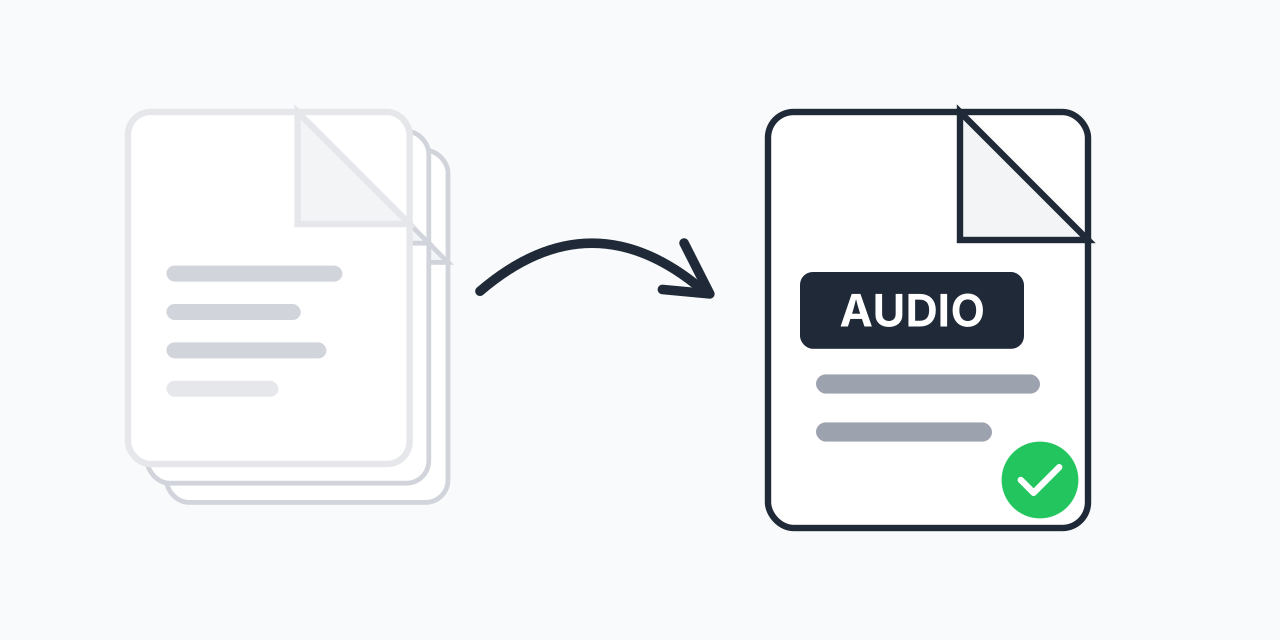
ChangeMyFile converts between 12+ audio formats - MP3, WAV, FLAC, AAC, OGG, M4A, WMA, AIFF, OPUS, AMR and more. Upload your file, pick a format, download the result. No software, no account, no limits.
Not sure which format you need? Start with the problem you are trying to solve:
- File will not play on your device - car stereo, Samsung TV, Android phone, old MP3 player - see the device compatibility table below
- File is too large to share - convert WAV or FLAC to MP3 to shrink it significantly
- Submitting to Spotify, a podcast host, or a mastering engineer - see platform requirements below
- Have a legacy file nothing plays - AMR voice memo, old WMA rip, OGG from a game - convert to MP3
Supported Audio Formats
- MP3 - Universal. Plays on every device made in the last 25 years.
- WAV - Uncompressed lossless. The right format for audio editing.
- FLAC - Lossless with compression. Half the size of WAV, identical quality.
- AAC - Better quality than MP3 at the same bitrate. Used natively by Apple and YouTube.
- M4A - Apple container for AAC audio. iPhone voice memos, iTunes downloads, GarageBand exports.
- OGG - Open format. Native on Android. Common in game audio files.
- OPUS - Modern codec used by Discord, Zoom, and web browsers for real-time audio.
- WMA - Legacy Windows format from early 2000s Windows Media Player rips.
- AIFF - Apple uncompressed format. Sonically identical to WAV, different ecosystem.
- AMR - Android voice recorder format. Optimised for speech, plays nowhere outside Android.
Device Compatibility - Which Format Plays Where
The most common reason people convert audio is that a file will not play on a specific device. This table answers that directly.
| Format | iPhone / iPad | Android | Car stereo (USB) | Samsung / LG TV (USB) | Windows PC | Mac |
|---|---|---|---|---|---|---|
| MP3 | Yes | Yes | Yes - universal | Yes | Yes | Yes |
| WAV | Yes | Yes | Most models | Yes | Yes | Yes |
| FLAC | iOS 11+ only | Yes - native | Newer models only | Select models | Needs app | Yes |
| AAC / M4A | Yes - native | Android 4+ | Usually yes | Yes | Yes | Yes - native |
| OGG | No - needs app | Yes - native | Rarely | Rarely | Needs app | Needs app |
| OPUS | No - needs app | Android 5+ | No | No | Needs app | Needs app |
| WMA | No | Yes | Older models | Yes (older TVs) | Yes | Needs app |
| AIFF | Yes | No | Rarely | No | Needs app | Yes - native |
| AMR | No | Yes - native | No | No | No | No |
Safe universal choice: If you need a file to play anywhere without thinking about it, convert to MP3 at 320kbps. It plays on every device made in the last 25 years.
Lossless vs Lossy - When It Actually Matters
Most guides tell you lossless is always better. That is not the full picture.
When lossless (FLAC / WAV / AIFF) matters
- Editing audio - work in WAV or AIFF inside your editor (Audacity, Logic, Adobe Audition), export to MP3 as the last step. Every re-encode from a lossy format compounds quality loss.
- Submitting to a music distributor - Spotify, Apple Music, and Bandcamp want FLAC or WAV (24-bit preferred). They do their own compression. If you deliver MP3, you are compressing twice.
- Sending to a mastering engineer - always WAV or AIFF, never MP3. A mastering engineer working from a 320kbps MP3 is limited by the data that was already discarded.
- Archiving - if you ripped a CD or have a high-quality source, store it as FLAC. You can always convert to MP3 later. You can never get back what MP3 discarded.
When lossless does not matter
- Listening via Bluetooth - Bluetooth itself is lossy compression. Most earbuds (AirPods, Galaxy Buds) use SBC or AAC Bluetooth codecs that compress the audio in transmission. The difference between a FLAC file and a 320kbps MP3 becomes inaudible before it reaches your ears.
- Background listening, commuting, gym - ambient noise masks the subtle differences that only exist in controlled listening conditions.
- Budget playback equipment - speakers or earphones with a weak frequency response are the bottleneck, not the audio format.
The one thing to know about converting MP3 to FLAC
It does not improve quality. When MP3 encoding discards frequency data, that data is permanently gone. FLAC cannot restore it - it stores exactly what is there, in a lossless container. The result is a larger file with identical quality to the MP3 you started from. Convert MP3 to FLAC only if a platform or workflow requires a lossless container.
Format Guide - The One Thing You Need to Know
MP3
128kbps MP3 is audibly bad for music - cymbals sound watery, bass gets muddy. 192kbps is the minimum for music. 320kbps is what we use, and it is indistinguishable from lossless for most people on most equipment.
FLAC
FLAC only preserves what is already in your source file. If your source is a CD rip or a lossless recording, FLAC stores it perfectly at roughly half the size of WAV. If your source is an MP3, converting to FLAC stores the same degraded audio in a larger file.
WAV
WAV is the right format for editing, not for storage. A 3-minute WAV file is around 30 MB. Use WAV while working inside an audio editor, then export to your target format when done.
AAC / M4A
AAC is technically superior to MP3 at the same bitrate, especially noticeable below 192kbps. M4A is just AAC audio inside an Apple container - the audio is identical. Many non-Apple devices fail to play M4A not because of the codec but because they do not recognise the .m4a extension. Converting M4A to MP3 solves this.
OGG
Most OGG files people encounter were extracted from games - Minecraft, World of Warcraft, and most indie games store audio as OGG because MP3 was patented when those games were made. If you extracted a sound effect or soundtrack from a game, convert it to MP3 to play it anywhere.
OPUS
Opus is what Discord, Zoom, and WebRTC use for real-time voice and calls. You are unlikely to encounter it unless you are extracting audio from a call recording or web app. Convert to MP3 for general playback.
WMA
WMA is a legacy format from Windows Media Player in the early 2000s. Non-DRM WMA files convert fine. DRM-protected WMA files cannot be converted by any online tool - they require Microsoft's Digital Rights Update Tool and only work on the original PC with the original licences. If your WMA conversion is failing, DRM is likely the reason.
AIFF
AIFF and WAV are sonically identical - null tests show zero difference between them. AIFF is Apple's uncompressed format; WAV is the equivalent from the Windows world. Converting AIFF to WAV loses nothing and improves compatibility with non-Apple workflows.
AMR
AMR was designed for mobile phone voice calls at very low bitrates. Android voice recorder apps use AMR. It sounds acceptable for spoken word and terrible for music. Nothing outside of Android plays it natively - convert to MP3 to use it anywhere.
MP3 Bitrate Guide
| Bitrate | Quality | Best for |
|---|---|---|
| 64 kbps | Audibly degraded - robotic, muffled | Speech only, extreme size constraints |
| 96 kbps | Acceptable for speech | Podcast streaming, voice memos |
| 128 kbps | Passable but artefacts audible on headphones | Voice-heavy content only |
| 192 kbps | Transparent for most casual listeners | General music, streaming |
| 256 kbps | Essentially transparent | Music library, daily listening |
| 320 kbps | Maximum standard MP3 - indistinguishable from lossless for most listeners | Music you care about, anything you will keep |
We convert to 320kbps by default. Classical music and acoustic recordings are most sensitive to low bitrates - complex high-frequency content is what MP3 discards first.
Which Format Should I Use?
Playing audio on a device
- iPhone or iPad - AAC (M4A) or MP3. M4A gives slightly better quality; MP3 is more portable.
- Android phone - MP3 or AAC. Both play natively.
- Car stereo via USB - MP3 is the safest choice. Check your car manual before trying FLAC.
- Samsung or LG TV via USB - MP3 or AAC. Avoid OGG, OPUS, AMR.
- Older MP3 player - MP3 only.
- Windows PC - Any format works natively except OGG and OPUS.
- Mac - MP3, AAC, WAV, AIFF all work natively. FLAC works on macOS 10.13+.
Editing audio
Convert to WAV first. Edit in WAV. Export to your target format as the final step. Never edit in MP3 - every save re-encodes and compounds quality loss.
Submitting to a platform
- Spotify / Apple Music / Bandcamp - FLAC or WAV, 16-bit minimum, 24-bit preferred.
- Podcast host - MP3 at 128kbps mono (speech) or 192kbps stereo (music).
- Mastering engineer - WAV or AIFF. Never MP3.
- YouTube - AAC or WAV. YouTube re-encodes everything anyway.
Archiving long-term
FLAC. Lossless, roughly half the size of WAV, and you can always convert to any format later. A FLAC master means you never lose quality to a conversion you cannot undo.
Sharing via email or messaging
MP3 at 192-320kbps. Small enough to attach, plays on anything the recipient has.
Popular Audio Conversions
FLAC to MP3
Convert lossless FLAC to MP3 for compatibility and smaller file sizes. Since you are converting from a lossless source, you preserve as much quality as MP3 can represent. We use 320kbps.
M4A to MP3
The most common Apple compatibility fix. M4A files from iPhone, iTunes, and GarageBand do not play on many non-Apple devices - not because of audio quality, but because the .m4a extension is not recognised. Convert to MP3 and it plays everywhere.
WAV to MP3
Reduce a 30 MB WAV to a 7 MB MP3 for sharing or portable storage. Keep the original WAV as your master if you want to re-edit later.
MP3 to WAV
Some audio software requires WAV input. Converting MP3 to WAV gives you a WAV container but does not restore quality lost in the original MP3 encoding. Use it for workflow compatibility, not quality improvement.
OGG to MP3
Convert game audio files or Android recordings from OGG to MP3 for playback on any device or player.