
ChangeMyFile - Free Online File ConverterChangeMyFile
Trusted by thousands of users worldwide

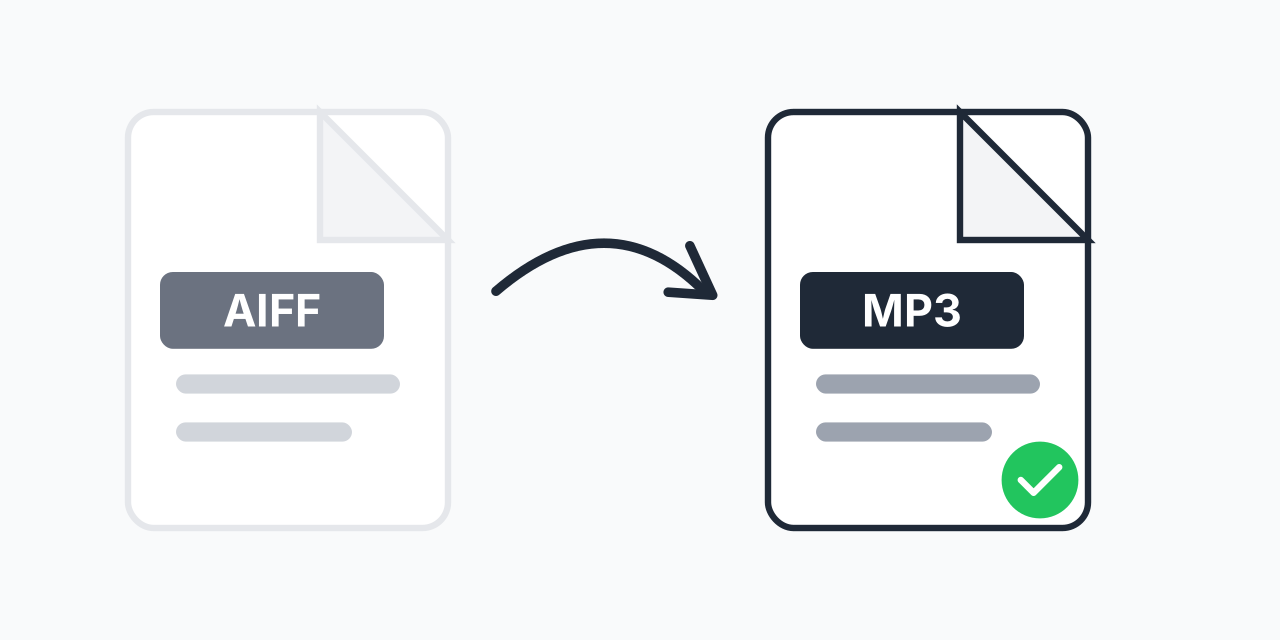
Convert AIFF to MP3 - Shrink Files, Keep Quality

Transform large AIFF audio files into compact MP3s. Play anywhere, share easily.

Step 1: Upload your files

You can also Drag and drop files.

Step 2: Choose format
Step 3: Convert files

Read Terms of use before using

Share:fXin@
500+ Formats
Lightning Fast
100% Secure
Always Free
Cloud Processing

Large Audio Files Taking Up Space?

AIFF files deliver excellent audio quality, but they're enormous. A single 4-minute song in AIFF format takes around 40MB of storage. That same song as an MP3? About 4MB. Converting to MP3 gives you 90% space savings while keeping your music sounding great.

If you work with AIFF files from Logic Pro, GarageBand, or professional recording sessions, converting to MP3 makes your audio portable and universally compatible.

How to Convert AIFF to MP3

  1. Upload your AIFF file - Drag and drop or click to select your audio
  2. Confirm MP3 output - MP3 is selected as the default for maximum compatibility
  3. Download your MP3 - Your compressed audio is ready to use anywhere

The entire process happens in your browser. No software downloads, no account required.

Why AIFF Files Are So Large

Apple developed AIFF (Audio Interchange File Format) in 1988 for professional audio work. Unlike MP3, AIFF stores audio without any compression:

  • Uncompressed audio - Every sound wave is stored exactly as recorded
  • CD-quality standard - 16-bit, 44.1kHz sampling rate
  • Lossless quality - No data is discarded during encoding

This makes AIFF perfect for audio editing but impractical for everyday listening or sharing. MP3 uses smart compression to reduce file size by roughly 11:1 while preserving what human ears actually hear.

When to Convert AIFF to MP3

Sharing Music

Email attachments have size limits. A single AIFF song might exceed them. MP3 files share easily via email, messaging apps, or file transfer services.

Mobile Listening

Your phone's storage fills up fast with AIFF files. In our testing, converting a 50-song album from AIFF to MP3 freed up over 1.5GB of space.

Web Uploads

Platforms like SoundCloud, podcast hosts, and websites typically accept MP3 but may reject or poorly handle AIFF uploads.

Non-Apple Devices

Android phones, Windows Media Player, and many car stereos don't support AIFF natively. MP3 works on virtually every device made in the last 25 years.

AIFF vs MP3 - What Changes

Here's what happens when you convert:

  • File size - Drops by approximately 90%
  • Compatibility - Increases dramatically (MP3 works everywhere)
  • Audio quality - Slight reduction, but inaudible in most listening situations
  • Editability - MP3 is less ideal for professional editing (keep your AIFF masters)

For casual listening, streaming, or sharing, MP3 quality is more than sufficient. Audiophiles doing critical listening or producers needing source files should keep their originals.

Alternative Formats to Consider

MP3 is the most compatible choice, but depending on your needs:

  • AIFF to AAC - Better quality than MP3 at the same file size, ideal for Apple devices
  • AIFF to FLAC - Lossless compression (about 50% smaller), preserves full quality
  • AIFF to OGG - Open-source alternative to MP3, good quality-to-size ratio

For maximum compatibility across all devices, stick with MP3.

Works on Any Device

Convert AIFF to MP3 directly in your browser:

  • Mac, Windows, Linux, Chromebook
  • Chrome, Firefox, Safari, Edge
  • iPhone, iPad, Android tablets and phones

No plugins required. Your files stay private - conversion happens locally.

Pro Tip

When exporting from Logic Pro or GarageBand, export as AIFF first if you want maximum flexibility. You can always convert to MP3 for sharing while keeping the AIFF as your master copy. Never edit the MP3 and re-save - quality degrades with each generation.

Common Mistake

Deleting AIFF originals immediately after converting to MP3. MP3 conversion is one-way - you can't restore lossless quality. If storage is tight, archive your AIFF files to an external drive before deleting.

Best For

Converting music, podcasts, or voice recordings for sharing via email, uploading to websites, or playing on devices that don't support AIFF. Ideal when file size matters more than studio-grade quality.

Not Recommended

Don't convert to MP3 if you plan to edit the audio further in a DAW. Work with AIFF or WAV during editing, then convert to MP3 only for the final delivery format.

Frequently Asked Questions

For everyday listening, no. MP3 uses perceptual coding that removes frequencies most people can't hear. In casual listening tests, most people can't distinguish between a 256kbps MP3 and the AIFF original. Keep your AIFF files if you need to do professional editing later.

Roughly 10 times smaller. A 40MB AIFF file converts to approximately 4MB as an MP3. The exact ratio depends on audio content and bitrate settings, but expect around 90% size reduction.

Yes. Both applications export AIFF by default for highest quality. Our converter handles these files without issues. Just export from your DAW, then upload the AIFF here to convert to MP3.

AIFF is Apple's uncompressed audio format, similar to WAV on Windows. It's commonly used in professional audio production, CD mastering, and as an archive format when you need to preserve original quality. Most Apple devices and software support AIFF natively.

Yes. MP3 is universally supported on Android, while AIFF often isn't. Converting to MP3 ensures your audio works on virtually any smartphone, tablet, or computer regardless of operating system.

Yes. Upload several AIFF files and convert them all to MP3 in a single batch. This is helpful when converting albums or podcast episode libraries.

Yes, completely free with no hidden charges. There's no account required, no watermarks added, and no limits on file size or number of conversions.

If storage allows, yes. AIFF files preserve full audio quality and can be converted to any format later. MP3 is great for listening and sharing, but you can't convert MP3 back to lossless quality. Keep AIFF masters for important recordings.

We use high-quality settings that balance file size with audio fidelity. The output is suitable for music listening, podcasts, and general audio playback with no noticeable quality loss for most listeners.

Quick access to the most commonly used file conversions.