Why OGG Files Need Converting
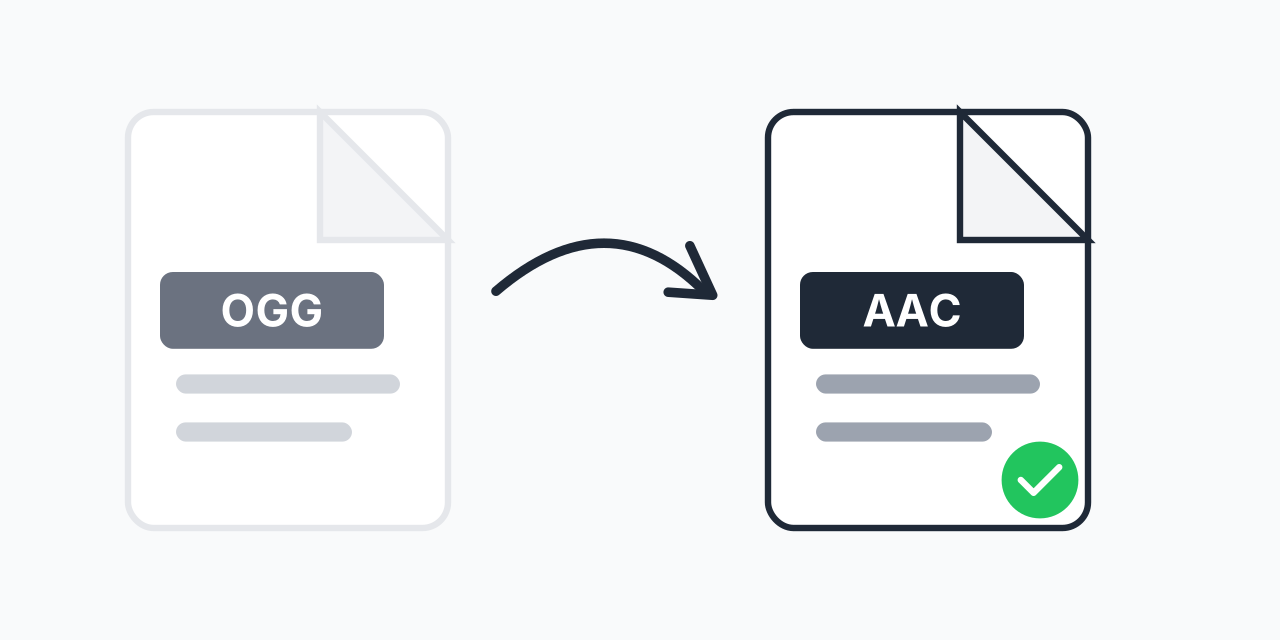
OGG Vorbis is an excellent open-source audio format used by Spotify and many gaming platforms, but it has one major limitation: Apple devices do not support it natively. Your iPhone, iPad, or iTunes library cannot play OGG files without conversion.
AAC (Advanced Audio Coding) is Apple's preferred audio format. It was designed as the successor to MP3 and delivers excellent quality at smaller file sizes. Every Apple device supports AAC out of the box, making it the ideal format when moving audio from the open-source world to the Apple ecosystem.
How to Convert OGG to AAC
- Upload your OGG file - Drag and drop or click to select your OGG Vorbis audio
- Select AAC as output - Our converter automatically optimizes settings for quality
- Download your AAC file - Ready for iTunes, iPhone, iPad, or any Apple device
The entire process takes seconds. No software installation, no account creation, no file size limits for reasonable uploads.
Quality Expectations
Converting from one lossy format to another (OGG to AAC) involves re-encoding, which theoretically causes some quality loss. However, in practical terms, if your source OGG file is 128 kbps or higher, the output AAC will sound essentially identical to most listeners.
For the best results, we recommend:
- Starting with the highest quality OGG source you have
- Keeping the same or similar bitrate during conversion
- If you have access to the original uncompressed source, convert from that instead
Our converter uses high-quality encoding settings to minimize any generational loss during the format change.
OGG vs AAC: Understanding the Formats
Both OGG Vorbis and AAC are lossy compression formats that reduce file size while maintaining audio quality. In our testing, both formats sound nearly identical at bitrates of 128 kbps and above. The choice between them typically comes down to device compatibility rather than audio quality.
OGG Vorbis Strengths
- Open-source and royalty-free
- Used by Spotify for streaming (up to 320 kbps for premium)
- Excellent quality at mid-to-high bitrates
- Supports bitrates up to 500 kbps
AAC Advantages
- Native support on all Apple devices
- Better quality at very low bitrates (below 96 kbps)
- Default format for YouTube, iTunes, and PlayStation
- Widely adopted industry standard
At 128 kbps and higher, both formats deliver quality that most listeners cannot distinguish from uncompressed audio. The real difference is where each format works.
When You Need This Conversion
Moving from Android to iPhone
Switching from Android to iOS? Your OGG music files will not play on your new iPhone. Convert them to AAC to maintain your music library on Apple devices.
Adding Music to iTunes
iTunes does not recognize OGG files. If you have audio in OGG format that you want in your iTunes library, AAC conversion is the cleanest solution since it is Apple's native format.
Podcast Distribution
Apple Podcasts requires AAC or MP3 format. If your podcast was recorded or edited in OGG format, you need to convert before submitting to Apple's directory.
Game Audio for iOS Development
Many game engines use OGG for audio assets due to its open-source license. When porting to iOS, developers often need to convert audio to AAC for native playback support.
Alternative Formats to Consider
AAC is not your only option for Apple compatibility. Depending on your needs, you might consider:
- OGG to MP3 - Universal compatibility across all devices, though slightly lower quality than AAC at equivalent bitrates
- OGG to M4A - M4A is the container format Apple uses for AAC audio, functionally identical for playback purposes
- OGG to ALAC - If you need lossless Apple-compatible audio, though file sizes will be much larger
For most users moving audio to Apple devices, AAC offers the best balance of quality, file size, and compatibility.
Batch Conversion
Have multiple OGG files to convert? Upload them all at once. Our converter handles batch processing, so you can transform your entire audio collection without converting files one at a time. This is particularly useful when migrating a music library or preparing multiple podcast episodes.
Browser-Based and Private
Our OGG to AAC converter runs entirely in your web browser. Your audio files are processed locally and are not uploaded to remote servers. This means:
- Faster conversion with no upload wait time
- Your audio stays private on your device
- Works on any platform: Windows, Mac, Linux, ChromeOS
- No software installation required
Just open your browser, convert your files, and close the tab. Nothing gets installed, nothing gets stored.