Need the Audio from an OGV Video?
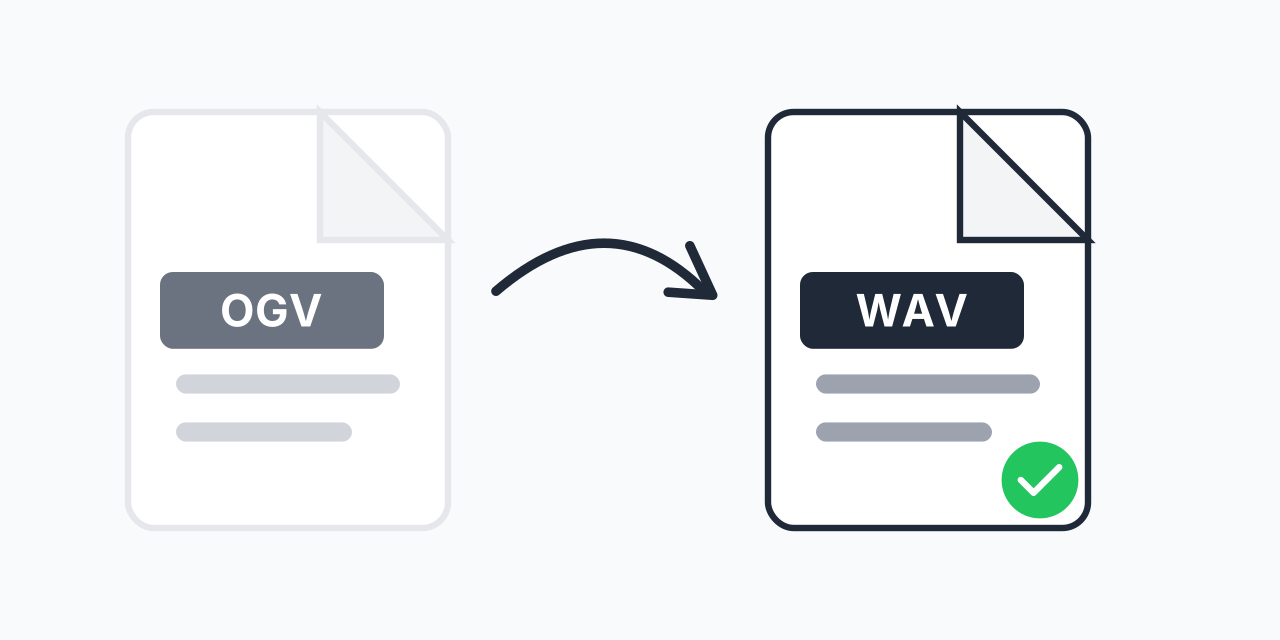
OGV files are video containers using the open-source Ogg format, commonly found on platforms like Wikipedia and Internet Archive. When you need just the audio track from an OGV file, converting to WAV gives you uncompressed, lossless quality perfect for editing or further processing.
Unlike compressed formats, WAV preserves every detail of the original audio. In our testing, extracting audio from a typical OGV file to WAV takes just seconds, regardless of video length.
How to Convert OGV to WAV
- Upload your OGV file - Drag and drop or click to select your video
- Confirm WAV as output - WAV is selected for maximum audio quality
- Download your audio - Get an uncompressed WAV file ready for any use
The entire process happens in your browser. No software installation, no account creation required.
Understanding OGV and WAV Formats
OGV is a video container format that typically uses Theora video codec with Vorbis or Opus audio. It was designed as a patent-free alternative to formats like MP4 and is widely used on open platforms.
WAV (Waveform Audio File Format) is the uncompressed audio standard developed by Microsoft and IBM. It stores raw audio data without any compression, making it ideal for:
- Audio editing - No quality loss during multiple edits
- Professional workflows - DAWs and audio software prefer uncompressed input
- Archiving - Preserve the original audio quality indefinitely
- Further conversion - Start with lossless for the best compressed output
When to Extract Audio from OGV
Content Archiving
You downloaded educational videos or documentaries in OGV format and want to archive just the audio content. Converting to WAV preserves perfect quality for long-term storage.
Audio Editing Projects
Need to extract dialogue, music, or sound effects from an OGV video for use in a podcast, remix, or multimedia project? WAV gives your audio editor the cleanest possible source material.
Format Compatibility
Some audio software does not recognize the Vorbis codec inside OGV files. Converting to WAV ensures compatibility with every audio application on the market.
Quality Considerations
OGV videos typically contain Vorbis-compressed audio, which is already a lossy format. When converting to WAV, you get an exact representation of that audio without any additional quality loss.
The resulting WAV file will be larger than the original OGV audio track because WAV stores uncompressed data. A 3-minute audio track might expand from 3-4 MB (Vorbis) to 30-35 MB (WAV). This is normal and represents the full audio fidelity.
If file size is a concern and you do not need lossless quality, consider OGV to MP3 for a compressed alternative.
Related Conversions
Working with OGV files but need a different output? Here are common alternatives:
- OGV to MP3 - Smaller files for music players and streaming
- OGV to MP4 - Convert the video to a more compatible format
Need to convert WAV files to another format after extraction? We support that too.
Works on Any Device
Our converter runs entirely in your browser:
- Windows, Mac, Linux, Chromebook
- Chrome, Firefox, Safari, Edge
- iPhone, iPad, Android
No downloads, no plugins, no waiting for server processing. Your files convert locally for maximum privacy and speed.