Need to Extract Audio from OGV Files?
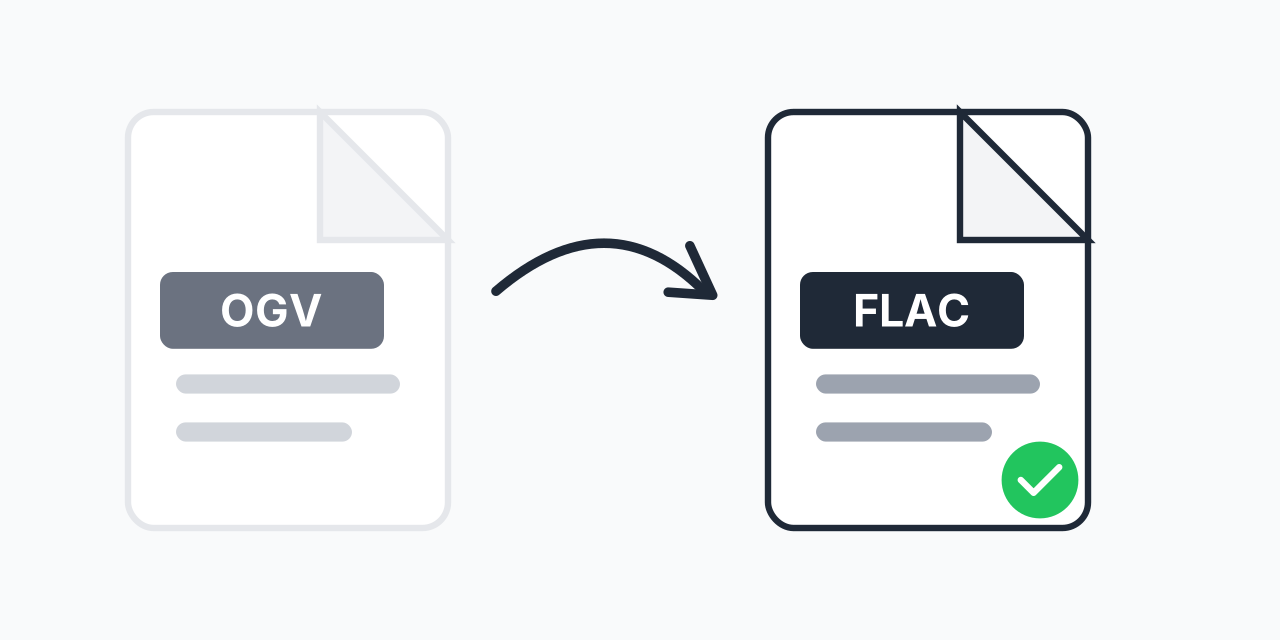
OGV files contain video encoded with Theora and audio typically encoded with Vorbis. When you need just the audio track, converting to FLAC preserves the original quality without any degradation. Unlike MP3 conversion, FLAC is lossless, meaning you keep every bit of audio data from the source.
This matters for archiving, audio editing, or when the OGV contains music or dialogue you want to preserve in the highest quality possible. Our converter extracts the audio stream and encodes it as FLAC efficiently, right in your browser.
How to Convert OGV to FLAC
- Upload your OGV file - Drag and drop or click to select your video
- Select FLAC as output - Choose FLAC for lossless audio extraction
- Download your audio - Get your FLAC file ready for use
The entire process happens in your browser. No software to install, no accounts to create.
Why Choose FLAC Over Other Audio Formats?
When extracting audio from OGV files, you have several format options. Here's why FLAC often makes the most sense:
- Lossless quality - FLAC compresses without discarding any audio data
- Smaller than WAV - In our testing, FLAC files are typically 50-60% smaller than equivalent WAV files
- Wide compatibility - Most modern audio players and editors support FLAC
- Metadata support - FLAC handles tags for artist, album, and track information
If file size is more important than perfect quality, consider OGV to MP3 conversion instead. MP3 creates smaller files but loses some audio information in the process.
Understanding OGV Audio Tracks
OGV is an open-source video container format from the Xiph.Org Foundation. The audio inside is usually Vorbis (similar to the audio in OGG files) or sometimes Opus. Both are lossy formats, so the audio has already undergone some compression when it was originally created.
Converting to FLAC preserves exactly what's there without adding further quality loss. You can't recover detail that was already compressed away, but you can prevent any additional degradation. This makes FLAC the right choice when you plan to edit the audio or want an archival-quality copy.
Common Use Cases
Audio Editing Projects
When importing audio into a DAW (digital audio workstation) like Audacity, Reaper, or Logic, starting with lossless FLAC means your edits won't compound quality loss. Edit, process, and export without degrading the source.
Archiving Web Videos
OGV files are common on Wikipedia and other open-source platforms. If you're archiving educational content or Creative Commons media, FLAC preserves the audio portion at maximum quality.
Podcast and Music Extraction
Extracting audio from video recordings of podcasts or live music? FLAC keeps the audio pristine for your collection or further editing.
Alternative Conversions
Depending on your needs, other formats might work better:
- OGV to WAV - Uncompressed audio, largest file size, universal compatibility
- OGV to MP3 - Smaller files, plays everywhere, some quality loss
- OGV to OGG - Extract just the Vorbis audio track without re-encoding
FLAC strikes the best balance between quality preservation and file size for most archival and editing workflows.
Works on Any Device
Our OGV to FLAC converter runs entirely in your browser:
- Windows, Mac, Linux, Chromebook
- Chrome, Firefox, Safari, Edge
- No software installation required
- Files stay on your device for privacy
Whether you're on a desktop workstation or a laptop, conversion happens locally without uploading to external servers.