Need the Audio from Your OGV Video?
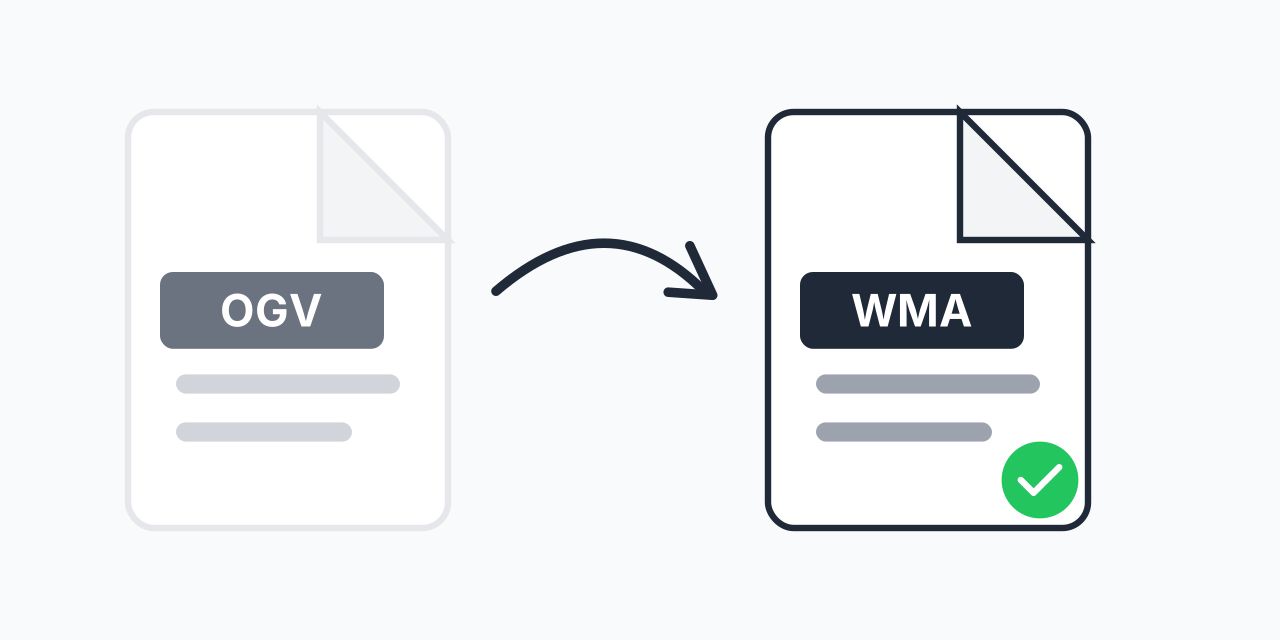
OGV files contain video encoded with the open-source Theora codec, but sometimes you only need the audio track. Maybe it's a lecture recording, a podcast with video, or background music from a video project. Converting to WMA format extracts just the audio, giving you a smaller file that plays natively on Windows devices.
WMA (Windows Media Audio) offers efficient compression with good quality retention, especially at lower bitrates. If you're working within the Windows ecosystem, WMA integrates seamlessly with Windows Media Player and older Windows-based systems.
How to Convert OGV to WMA
- Upload your OGV file - Drag and drop your video or click to browse your files
- Select WMA as output - Choose WMA from the available audio formats
- Download your audio - Get your extracted WMA file ready for playback
The entire process happens in your browser. No software installation, no account creation, no waiting in queues.
Understanding OGV and WMA Formats
OGV is a video container format developed by the Xiph.Org Foundation. It typically uses the Theora video codec (derived from VP3) and Vorbis audio codec. The format was designed for royalty-free web video streaming, particularly for HTML5 video playback before MP4 became the dominant standard.
WMA is Microsoft's proprietary audio format, part of the Windows Media framework. It comes in several variants: WMA Standard for general use, WMA Pro for high-resolution audio, WMA Lossless for archival quality, and WMA Voice for speech content. For most conversions, WMA Standard at 128-192 kbps provides excellent quality with reasonable file sizes.
Technical Comparison
| Aspect | OGV (Source) | WMA (Output) |
|---|---|---|
| Type | Video container (Theora/Vorbis) | Audio only |
| Compression | Lossy video + audio | Lossy audio (or lossless variant) |
| Bitrate Range | Variable (video + audio) | 5-384 kbps (standard) |
| Best For | Web video, open-source projects | Windows playback, smaller files |
| Licensing | Free, open-source (BSD) | Microsoft proprietary |
When to Extract Audio from OGV
Lecture and Educational Content
Many educational platforms historically used OGV for course videos due to its royalty-free nature. If you want to listen to lectures during commutes or workouts, extracting the audio to WMA creates a portable audio file that works on Windows phones and MP3 players with WMA support.
Podcast Recordings with Video
Some podcasters record video versions of their shows. If you prefer audio-only listening, converting to WMA removes the video component while preserving the conversation. In our testing, a 45-minute OGV video of about 200MB typically produces a WMA file under 30MB at 128 kbps.
Background Music and Sound Effects
Video editors and content creators sometimes store audio assets within video containers. Extracting to WMA gives you a standalone audio file for use in Windows-based production workflows.
Legacy Windows Device Compatibility
Older Windows Mobile devices, Zune players, and some in-car entertainment systems play WMA natively but may not support OGV. Converting ensures your audio works on these devices without additional software.
Quality Considerations
When converting OGV to WMA, you're extracting the existing audio track and re-encoding it. The original OGV file typically contains Vorbis audio, which is already a lossy format. Re-encoding to WMA adds another generation of compression.
For best results:
- Use 128 kbps or higher - WMA performs well at this bitrate, providing near-CD quality
- 44.1 kHz sample rate - Standard CD quality that works everywhere
- Consider the source quality - If the original OGV has low-bitrate audio, increasing WMA bitrate won't improve quality
WMA's efficient compression means it often sounds better than MP3 at equivalent bitrates below 128 kbps. This makes it particularly suitable for speech content where file size matters more than audiophile quality.
Alternative Output Formats
WMA works well for Windows-centric workflows, but consider these alternatives based on your needs:
- OGV to MP3 - Universal compatibility across all devices and platforms
- OGV to OGG - Extract audio without format change (Vorbis audio in OGG container)
- OGV to WAV - Uncompressed audio for editing or archival
Choose MP3 if you need maximum device compatibility. Choose OGG if you want to avoid re-encoding the Vorbis audio. Choose WAV if you plan to edit the audio further. WMA remains the best choice for dedicated Windows workflows.
Browser-Based Conversion
Our converter works entirely in your web browser. This means:
- No software to download or install
- Works on Windows, Mac, Linux, and Chromebook
- Compatible with Chrome, Firefox, Safari, and Edge
- Files stay on your device during processing
Whether you're on a work computer where you can't install software or simply prefer not to clutter your system with single-purpose apps, browser-based conversion handles the job efficiently.