
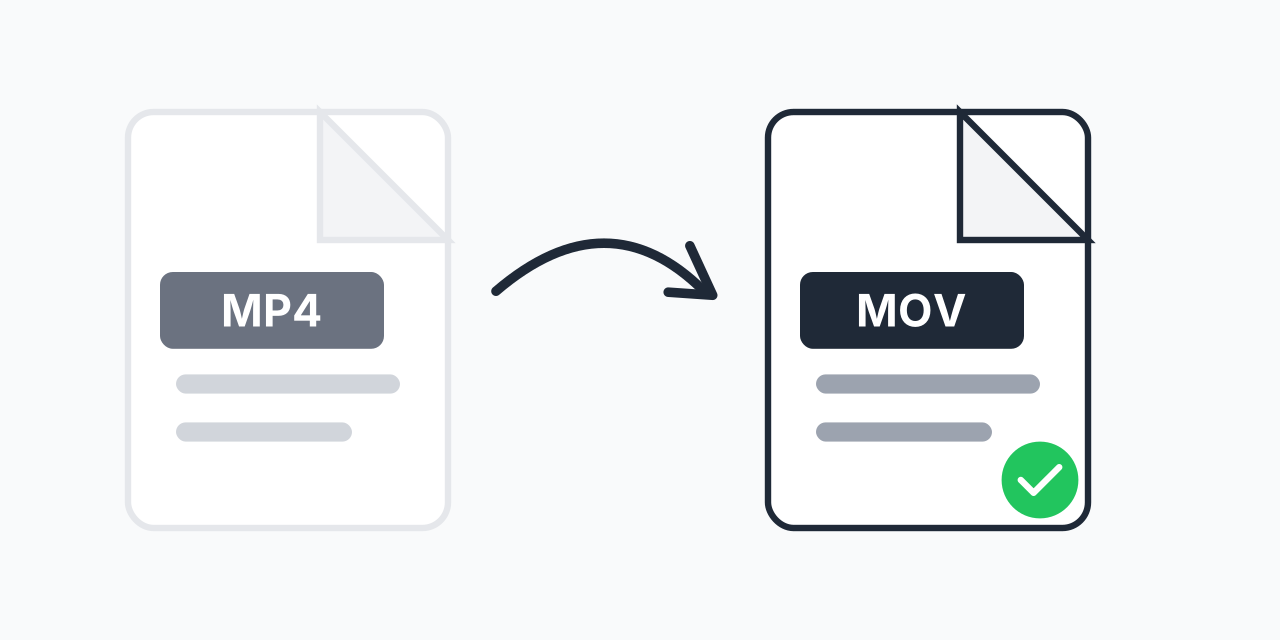
MP4 Files Causing Problems in Final Cut Pro?
You import an MP4 into Final Cut Pro and something goes wrong. Maybe you see 'Unsupported Frame Rate' errors. Perhaps the video imports as audio only, leaving you with sound but no picture. Or the editing timeline stutters and lags because H.264 was never designed for frame-by-frame editing.
MOV is Apple's native container format, built specifically for QuickTime and optimized for Final Cut Pro workflows. While both formats can hold the same codecs, MOV unlocks Apple-specific features like ProRes encoding and alpha channel transparency that MP4 simply cannot support.
How to Convert MP4 to MOV
- Upload your MP4 file - Drag and drop or select your video from any device
- Confirm MOV output - Your file converts to Apple-optimized QuickTime format
- Download your MOV file - Ready for smooth editing in Final Cut Pro or iMovie
Conversion typically takes seconds to a few minutes depending on file size. No software installation needed, and processing happens securely in your browser.
MP4 vs MOV: Technical Differences That Matter
Both MP4 and MOV are container formats based on the ISO base media file format. The containers themselves can hold identical video and audio codecs. However, key differences affect professional workflows.
- Codec support - MOV supports ProRes, Animation (RLE), and other Apple-specific codecs that MP4 cannot contain
- Alpha channel - MOV supports transparency for compositing work; MP4 has no alpha channel support
- Editing optimization - ProRes in MOV is designed for editing with fast seeking; H.264 in MP4 is optimized for delivery and streaming
- Metadata handling - MOV preserves more extensive metadata from Apple devices and professional cameras
- File size trade-off - When using identical codecs, file sizes are nearly identical; ProRes MOV files are larger but edit faster
In our testing, the same H.264 video in MP4 vs MOV containers shows identical quality. The real benefits come from accessing MOV-exclusive features like ProRes and transparency.
When MP4 to MOV Conversion Actually Helps
Final Cut Pro Import Issues
Final Cut Pro officially supports MP4, but real-world experience tells a different story. Users commonly encounter import failures, audio-only imports, and timeline stuttering with certain MP4 files. The codec inside the MP4 may not match what Final Cut Pro expects. Converting to MOV often resolves these cryptic compatibility issues.
Professional Video Editing with ProRes
H.264 and H.265 are delivery codecs optimized for small file sizes. Every frame references other frames, making random seeking and scrubbing slow. ProRes, only available in MOV containers, is an editing codec. Each frame decodes independently, giving you smooth playback at any timeline position and faster rendering for effects-heavy projects.
Compositing and Motion Graphics
If you need transparency in your video for overlays, lower thirds, or motion graphics, MOV is your only option. The QuickTime Animation codec, Apple ProRes 4444, and PNG codec all support alpha channels within MOV containers. MP4 cannot store transparency data at all.
Apple Ecosystem Optimization
QuickTime Player, iMovie, Motion, and Compressor all handle MOV files natively. While they support MP4 playback, MOV integrates more seamlessly with Apple-specific features like chapters, audio tracks, and timecode.
MP4 vs MOV: Honest Comparison
Not every MP4 needs to become MOV. Understanding when the conversion provides real value helps you avoid unnecessary processing.
- Convert to MOV when: Importing into Final Cut Pro with errors, needing ProRes for editing performance, requiring alpha channel transparency, or working extensively within Apple software ecosystem
- Keep MP4 when: Sharing videos online, uploading to YouTube or social media, streaming to devices, or when your MP4 already works fine in your editing software
- Understand this: If both containers hold H.264 video, quality and file size are identical. The conversion only matters when accessing MOV-exclusive features or fixing compatibility issues
YouTube, Facebook, Instagram, and most streaming platforms prefer MP4. Only convert to MOV when you have a specific Apple workflow reason to do so.
Understanding Codecs Inside Containers
A container (MP4 or MOV) holds encoded video and audio tracks. The codec determines quality, file size, and compatibility. Common codecs you will encounter:
- H.264 (AVC) - Universal playback, efficient compression, works in both MP4 and MOV
- H.265 (HEVC) - 50% smaller files than H.264, works in both containers but slower to encode
- Apple ProRes - MOV only, designed for editing, large files but instant seeking and rendering
- ProRes 4444 - MOV only, includes alpha channel for transparency
- Animation (RLE) - MOV only, lossless with alpha, huge files but perfect quality
When we convert your MP4 to MOV, we preserve your original video codec. For ProRes conversion, you need specialized encoding which significantly increases file size.
Batch Convert Multiple Files
Preparing a project with dozens of MP4 clips for Final Cut Pro? Upload multiple files at once and download them all as MOV. Batch conversion saves hours compared to processing each clip individually, especially when standardizing footage from multiple cameras or sources.
Works on Any Device
Our browser-based converter runs entirely in your web browser. No software to install, no QuickTime needed on Windows, and no account required.
- Windows, Mac, Linux, ChromeOS
- Chrome, Firefox, Safari, Edge
- iPhone, iPad, Android devices
Convert from any device, then import your MOV files into your Apple editing workflow.