
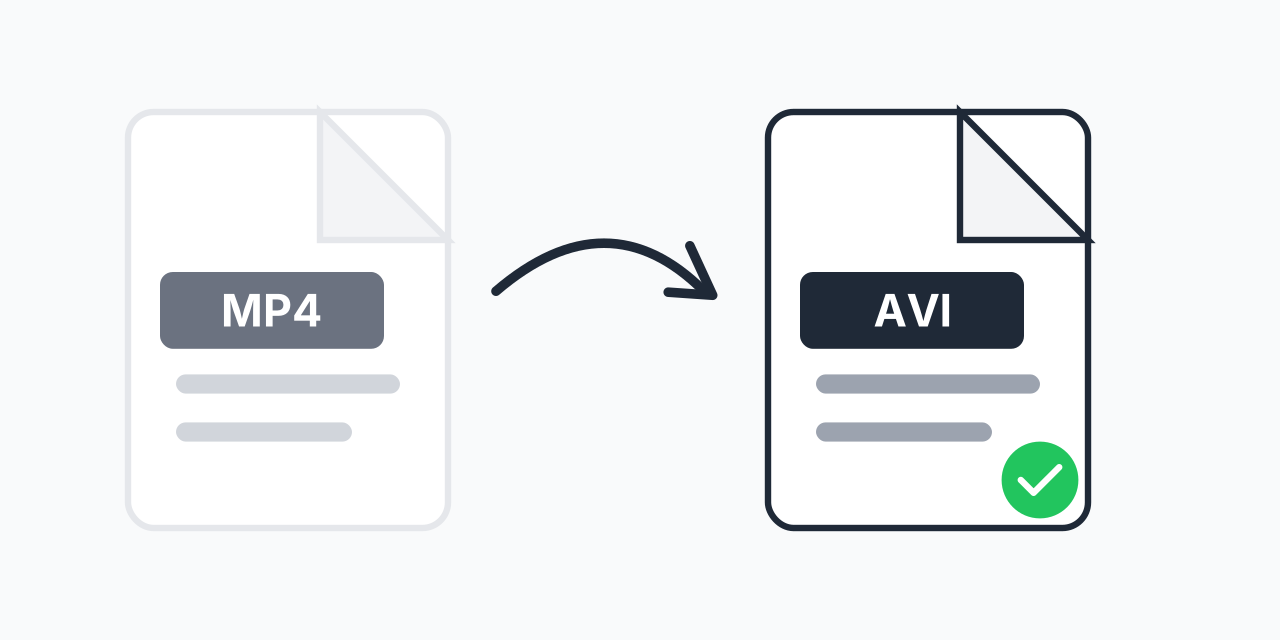
MP4 Files Not Playing on Your DVD Player or Older Device?
MP4 is the modern standard for video, but older DVD players, legacy Windows software, and certain hardware simply refuse to play it. You see that frustrating 'unsupported format' message, and suddenly your carefully recorded videos are useless on the device you need them on.
AVI format, developed by Microsoft in 1992, remains the universal fallback for compatibility. Converting your MP4 files to AVI ensures playback on DivX-certified DVD players, older Windows editing software, and legacy media systems that predate modern codec support.
How to Convert MP4 to AVI
- Upload your MP4 file - Drag and drop or select your video file from any device
- Confirm AVI output - Your file converts to widely compatible AVI format automatically
- Download your AVI file - Get your legacy-compatible video file instantly
The entire process takes seconds to minutes depending on file size. No software installation required, and your files are processed securely in your browser.
Understanding MP4 and AVI Format Differences
Both MP4 and AVI are container formats that can hold video and audio encoded with various codecs. The key differences affect when you should use each format.
- MP4 codecs - Typically uses H.264/AVC or H.265/HEVC for efficient compression with excellent quality
- AVI codecs - Commonly uses DivX, XviD, or MPEG-4 Part 2, which older devices understand natively
- File size comparison - AVI files are typically 2-3x larger than MP4 at equivalent quality due to less efficient compression
- Maximum resolution - AVI supports up to 1080p reliably, while MP4 handles 4K and 8K with modern codecs
- Subtitle support - MP4 natively supports embedded subtitles, AVI requires external SRT files
In our testing, a 100 MB MP4 file typically converts to approximately 150-250 MB in AVI format, depending on the video complexity and encoding settings.
When MP4 to AVI Conversion Makes Sense
DivX-Certified DVD Players
If you have a DVD player with the DivX logo, it expects AVI files encoded with DivX or XviD codecs. Burning MP4 files directly to disc often results in playback errors. Converting to AVI first ensures your home videos and movies play smoothly on your living room setup.
Older Video Editing Software
Legacy versions of Windows Movie Maker, older Adobe Premiere versions, and some industrial video systems were designed before H.264 became standard. These applications handle AVI files natively but may struggle with MP4 imports or require additional codec packs.
Surveillance and Industrial Systems
Many security camera systems, medical imaging devices, and industrial equipment use AVI as their native format. Converting MP4 footage to AVI allows integration with these specialized systems without compatibility issues.
Windows Media Player Classic Setups
Users with specific Windows Media Player configurations or older Windows versions often find AVI more reliable for local playback without hunting for codec packs.
MP4 vs AVI: Which Format to Choose
Both formats serve different purposes. Being honest about when each excels helps you make the right choice.
- Choose AVI when: Playing on older DVD players, using legacy Windows editing software, integrating with surveillance systems, or needing maximum compatibility with devices from the 2000s era
- Keep MP4 when: Sharing online, streaming to modern devices, storing on limited space, or needing 4K resolution support
- Consider alternatives: For web streaming use MP4, for professional editing use ProRes or DNxHD, for archiving consider lossless formats
Remember that MP4 files are smaller and work on more modern devices. Only convert to AVI when you have a specific compatibility requirement that demands it.
DVD Player Compatibility Requirements
Not all AVI files play on all DVD players. Based on our testing and user feedback, here are the technical parameters that ensure maximum compatibility:
- Maximum resolution - 720x576 (PAL) or 720x480 (NTSC) for best compatibility
- Video bitrate - Keep under 2000 kbps, or 1200 kbps if using AC3 audio
- File size limit - Files over 2 GB may cause playback issues on older players
- Avoid advanced encoding - QPel, GMC, and packed bitstreams often fail on consumer DVD players
- Audio codec - MP3 audio at 128-192 kbps works most reliably across devices
For guaranteed playback on any DVD player, converting to standard MPEG-2 and burning a proper DVD-Video disc remains the most reliable option, though AVI with DivX works well on certified players.
Batch Convert Multiple MP4 Files
Converting an entire folder of videos for your DVD collection? Upload multiple MP4 files at once and download them all as AVI. Batch conversion saves hours compared to processing files individually, perfect for digitizing home video archives or preparing content for legacy playback systems.
Works on Any Device
Our browser-based converter runs entirely in your web browser. No software to install, no plugins required, and no account needed to start converting.
- Windows, Mac, Linux, ChromeOS
- Chrome, Firefox, Safari, Edge
- iPhone, iPad, Android tablets and phones
Convert your MP4 files from any device, then transfer the AVI output to your target playback system.