Need Royalty-Free Audio from Your MP4 Videos?
You have an MP4 video with audio you need in OGG Vorbis format. Maybe you are building a game in Godot or Unity and need patent-free audio. Perhaps you are working on an open-source project that cannot include licensed codecs. Or you simply want smaller audio files with better quality than MP3 at the same bitrate.
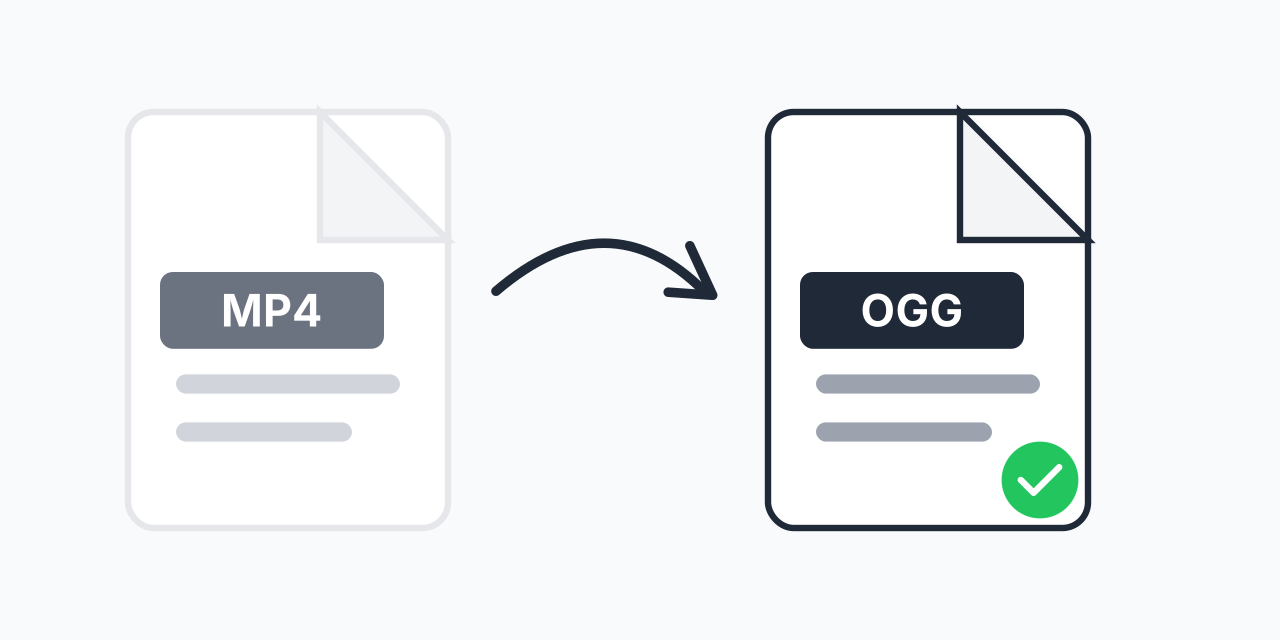
OGG Vorbis is completely royalty-free and open-source, making it the go-to format for game developers, web applications, and projects where licensing matters. Our converter extracts the audio from your MP4 and encodes it as high-quality OGG Vorbis, ready for any application that supports the format.
How to Convert MP4 to OGG
- Upload your MP4 file - Drag and drop your video or select it from your device
- Confirm OGG output - The converter extracts audio and encodes it as OGG Vorbis
- Download your audio file - Get your OGG file ready for games, web projects, or any Vorbis-compatible player
The entire process runs in your browser. No software installation needed, no account required, and your files stay private throughout the conversion.
Understanding OGG Vorbis Quality Levels
OGG Vorbis uses a quality scale from -1 to 10 rather than fixed bitrates. This variable bitrate (VBR) approach allocates more data to complex passages and less to simple ones, resulting in better quality per megabyte than fixed-bitrate formats.
- Quality 3 (default) - Approximately 110 kbps, better fidelity than MP3 at 128 kbps
- Quality 5 - Approximately 160 kbps, generally transparent for most listeners
- Quality 6-8 - Approximately 192-256 kbps, near-lossless for critical listening
- Quality 10 - Approximately 400 kbps maximum, exceeds MP3 ceiling of 320 kbps
In our testing, quality 5 provides the sweet spot for most uses, balancing file size with audio fidelity. Game developers often use quality 3-5 to minimize asset sizes while maintaining clear audio.
Why Game Developers Choose OGG
Godot Engine Requirements
If you are developing with Godot, you have likely discovered that the engine specifically requires OGG Vorbis for music and longer audio files. MP3 support exists but OGG remains the recommended format due to its open-source nature and Godot's philosophy of avoiding proprietary dependencies.
Unity and Unreal Compatibility
Both Unity and Unreal Engine fully support OGG Vorbis. Many developers choose OGG over MP3 to avoid potential licensing complications, especially for commercial releases. The format compresses well for game assets while maintaining quality during gameplay.
Web Audio Applications
For HTML5 games and web applications, OGG Vorbis has strong browser support in Chrome, Firefox, and Edge. While Safari historically favored AAC, modern web projects often provide both formats to ensure universal playback.
OGG vs AAC: When to Use Each Format
MP4 files typically contain AAC audio, which is already an efficient compressed format. Converting to OGG makes sense in specific situations, but not always.
- Choose OGG when: You need royalty-free audio for commercial projects, your game engine prefers OGG, you are building open-source software, or you want slightly better quality than MP3 at equivalent bitrates
- Choose AAC/M4A when: You primarily use Apple devices, need maximum iOS compatibility, or the audio will stay within the Apple ecosystem
- Stay with MP4 when: You need both video and audio together, or the AAC audio already meets your quality requirements
Be aware that converting AAC to OGG involves re-encoding, which means transcoding between two lossy formats. For best results, start with the highest quality source available.
Technical Specifications
OGG Vorbis offers flexible audio parameters suitable for various applications:
- Sample rates - Supports 8 kHz to 192 kHz, with 44.1 kHz and 48 kHz most common
- Channels - Mono, stereo, and multichannel up to 255 discrete channels
- Bitrate range - Variable from approximately 45 kbps to 500 kbps
- Container - OGG container with Vorbis audio codec, extension .ogg
The OGG container format was developed by the Xiph.Org Foundation specifically as an open alternative to proprietary formats. Unlike MP3 or AAC, there are no patent licensing requirements for encoding or decoding OGG Vorbis audio.
Compatibility Considerations
OGG Vorbis enjoys broad support, though with some notable exceptions:
- Full support: VLC, Firefox, Chrome, Edge, Audacity, most Linux players, Godot, Unity, Unreal Engine
- Limited support: Windows Media Player (requires codec), Safari (partial), older car stereos
- No native support: iOS default apps (use VLC or third-party players), some portable audio players
If your audio needs to play on Apple devices without third-party apps, consider AAC instead. For game development and web applications where you control the playback environment, OGG is an excellent choice.
Batch Convert Multiple Videos
Need to extract OGG audio from an entire video collection? Upload multiple MP4 files at once and convert them all in a single batch. This is particularly useful for preparing game audio assets, converting a podcast archive, or processing multiple recordings for a project.
Works on Any Device
Our browser-based converter runs entirely in your web browser with no plugins or downloads required.
- Windows, Mac, Linux, ChromeOS
- Chrome, Firefox, Safari, Edge
- iPhone, iPad, Android devices
Processing happens securely, and your files remain private throughout the conversion process.