
ChangeMyFile - Free Online File ConverterChangeMyFile
Trusted by thousands of users worldwide

Convert PNG to JPG – Smaller Files, Easy Sharing

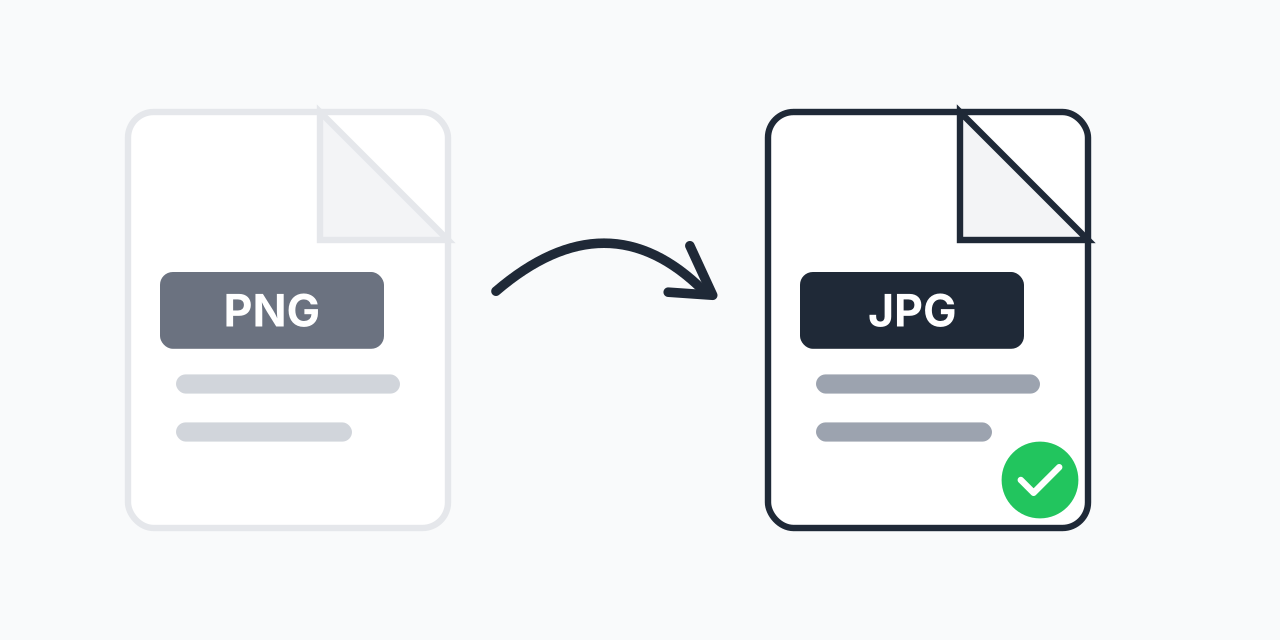
Convert PNG images to JPG for smaller file sizes and web sharing.

Step 1: Upload your files

You can also Drag and drop files.

Step 2: Choose format
Step 3: Convert files

Read Terms of use before using

Share:fXin@
500+ Formats
Lightning Fast
100% Secure
Always Free
Cloud Processing

Need Smaller Image Files?

PNG files are great for quality but often unnecessarily large for everyday use. A 5MB PNG photo might become a 500KB JPG with no visible difference—perfect for email, web upload, or saving storage space.

Converting PNG to JPG applies efficient compression designed for photographs. Your images look great while taking up far less space.

How to Convert PNG to JPG

  1. Upload your PNG file – Select your image
  2. Confirm JPG output – JPG provides efficient photo compression
  3. Download your file – Get your smaller, optimized image

Conversion happens in your browser—fast and private.

Why Convert PNG to JPG?

Dramatically Smaller Files

JPG compression is highly efficient for photos. File sizes typically reduce by 70-90%, depending on the image. Photos that are megabytes become hundreds of kilobytes.

Faster Uploads

Email attachments, social media posts, and website uploads go faster with smaller files. Many platforms have file size limits that large PNGs exceed.

Web Performance

Smaller images load faster on websites. For photography and general images, JPG is the web standard.

Universal Compatibility

JPG is the most widely supported image format. Every device, application, and platform handles JPG without issues.

When to Keep PNG

PNG is sometimes the right choice. Keep your image as PNG if:

  • Transparency needed – JPG doesn't support transparent backgrounds
  • Sharp edges/text – Logos and screenshots stay crisper in PNG
  • Archival purpose – PNG is lossless; JPG loses some data
  • Will edit repeatedly – PNG doesn't degrade with each save

For photos and general images where none of these apply, JPG is more practical.

Quality and Compression

JPG compression is lossy—some data is discarded for smaller files:

  • High quality (90%+) – Nearly identical to PNG, moderate size reduction
  • Standard quality (80-85%) – Excellent balance of quality and size
  • Web quality (70-75%) – Visible compression, much smaller files

For most uses, 80-85% quality is ideal—small files with imperceptible quality loss.

Transparency Warning

PNG transparency becomes solid color in JPG (usually white). If your PNG has a transparent background, it will appear as a solid background after conversion. For transparent images, keep using PNG or see our PNG to WebP converter which supports transparency.

Batch Convert Multiple Images

Have many PNGs to convert? Upload multiple files and convert them all to JPG in one batch. Optimize an entire folder of images at once.

Works on Any Device

Convert PNG to JPG in your browser:

  • Windows, Mac, Linux, Chromebook
  • Chrome, Firefox, Safari, Edge
  • iPhone, iPad, Android

How to convert PNG to JPG

Convert PNG into JPG for smaller size.

How to convert PNG to JPG
1

Upload your PNG file

Click Upload and select your PNG file from your device.

2

Confirm JPG as output

The JPG format is auto-selected for this page—confirm it (or choose if needed). JPG compresses well for the web.

3

Convert and download

Click Convert Now and download your JPG file. Preview in browser. Note: Some detail may be lost.

Tip: Convert PNG screenshots into JPG for email.

Expert Tips for PNG to JPG

Pro Tip

For website images, convert to JPG at 80-85% quality, then run through an additional optimizer like TinyJPG. This can reduce file sizes further without visible quality loss.

Common Mistake

Converting logos, icons, and graphics with text to JPG. These stay sharper in PNG. Save JPG for photographs; keep graphics as PNG or SVG.

Best For

Reducing photo file sizes for email, web upload, and storage. Essential for anyone with large PNG photo collections taking up unnecessary space.

Not Recommended

Don't convert if you need transparency, have sharp graphics/text, or plan to edit the image repeatedly. PNG is better for these use cases.

Frequently Asked Questions

Everything you need to know about PNG to JPG conversion.

Typically 70-90% smaller for photos. A 5MB PNG might become 500KB as JPG with no visible quality difference. Graphics with solid colors see smaller reductions.

JPG uses lossy compression—some data is discarded. At high quality settings (85%+), the loss is imperceptible to most viewers. Lower quality = smaller files but visible compression.

JPG doesn't support transparency. Transparent areas become solid color (usually white). To keep transparency, use PNG or convert to WebP instead.

Yes, identical. JPG and JPEG are the same format with different extension lengths. Our converter produces .jpg files.

Usually no. Screenshots with text and sharp edges look better in PNG. JPG compression can blur text. Use JPG for photos, PNG for screenshots.

PNG uses lossless compression—no data is discarded. This preserves quality but creates larger files. JPG's lossy compression trades some quality for much smaller sizes.

You can change the format, but you can't recover lost data. Converting JPG to PNG creates a lossless file but doesn't restore quality lost during JPG compression.

85% is a good default—excellent quality with good compression. Use 90%+ for important photos, 70-75% when file size is critical.

Quick access to the most commonly used file conversions.