
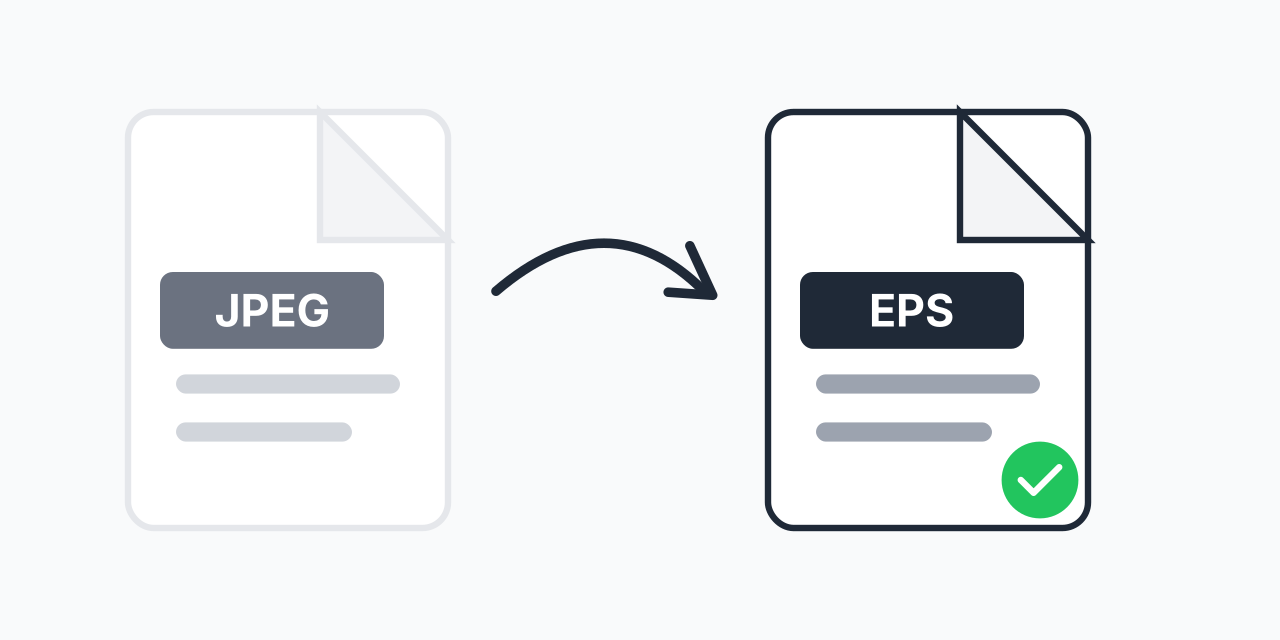
Why Convert JPEG to EPS?
You have a JPEG image that needs to go to a print shop, or you need to place it in Adobe Illustrator for a design project. The printer asks for EPS format, or your design workflow requires it.
EPS (Encapsulated PostScript) is the industry standard for professional printing. While JPEG files work great for web and screen display, EPS files are what print shops and graphic designers have relied on since 1987. Converting your JPEG to EPS ensures compatibility with professional print workflows and design applications.
How to Convert JPEG to EPS
- Upload your JPEG file - Drag and drop or click to select your image
- Confirm EPS as output format - EPS is selected for print-ready output
- Download your EPS file - Ready for print shops and design software
The conversion takes seconds. No software installation required, no account signup needed.
Quality Considerations
The quality of your EPS output depends entirely on your source JPEG. A high-resolution JPEG produces a high-quality EPS. A heavily compressed or small JPEG will have the same limitations in EPS format.
For best results:
- Start with the highest quality JPEG available
- Use images at the resolution required for your print size (typically 300 DPI for print)
- Avoid converting already-compressed JPEGs multiple times
In our testing, converting a 3000x2000 pixel JPEG to EPS maintained full image fidelity. The EPS file size was slightly larger than the original JPEG due to the PostScript container overhead.
Understanding the JPEG to EPS Conversion
JPEG is a raster format made of pixels. EPS can contain both raster and vector data. When you convert a JPEG to EPS, the image data becomes encapsulated within the EPS container format.
In our testing, the resulting EPS file maintains the original JPEG image quality while gaining compatibility with professional design software. The EPS wrapper allows the image to be placed, scaled, and manipulated within applications like Adobe Illustrator and CorelDRAW.
Technical Differences
- JPEG - Lossy compression, fixed resolution, 16.7 million colors, web-optimized
- EPS - Container format, PostScript-based, supports both raster and vector, print-optimized
The EPS format preserves your image while adding metadata and structure that professional software expects.
Who Needs JPEG to EPS Conversion?
Graphic Designers
Placing photos in Adobe Illustrator layouts often requires EPS format. When building complex designs with multiple image elements, EPS provides consistent handling across the project.
Print Professionals
Many print shops and large-format printers specifically request EPS files. Billboards, banners, and signage production often rely on EPS for reliable output. In our testing with various print workflows, EPS files imported cleanly into RIP (Raster Image Processor) software.
Marketing Teams
Brand assets often need to be delivered in multiple formats. Converting product photos to EPS ensures compatibility with any designer or printer your team works with.
Publishers
Magazine and book publishers using legacy publishing systems may require EPS format for image placement. The format has decades of backward compatibility.
When to Use EPS vs Other Formats
EPS remains essential for specific workflows, but it is not always the best choice:
Use EPS When:
- Your print shop specifically requests EPS format
- Working with older printing equipment or legacy systems
- Placing images in Adobe Illustrator or CorelDRAW projects
- Delivering files to clients who use professional design software
Consider Alternatives When:
- For modern print workflows, JPEG to PDF may be more universally accepted
- For web use, keep your original JPEG or convert to WEBP for smaller files
- For true vector output from graphics, consider JPEG to SVG
In our experience, print shops have moved toward PDF for many applications, but EPS remains the standard for large-format printing and signage.
Software Compatibility
Your converted EPS file works with all major design applications:
- Adobe Illustrator - Full support, native EPS handling
- Adobe Photoshop - Opens and places EPS files
- CorelDRAW - Complete EPS import capabilities
- Affinity Designer - Modern EPS support
- GIMP - Free software with EPS import (requires Ghostscript)
- Inkscape - Open-source vector editor with EPS handling
Professional print equipment and RIP software universally support the EPS format due to its PostScript foundation.
Batch Conversion
Need to convert multiple JPEG images to EPS? Upload all your files at once and convert them in a single batch. This is particularly useful when preparing entire photo sets for a print project or design deliverable.
Each file is processed individually, maintaining the original filename with the new .eps extension.
Browser-Based Conversion
Convert JPEG to EPS directly in your web browser:
- Windows, Mac, Linux, Chromebook
- Chrome, Firefox, Safari, Edge
- iPhone, iPad, Android tablets
No downloads required. No software installation. No account creation. Just upload, convert, and download your print-ready EPS files.