Why Convert PDF to PNG?
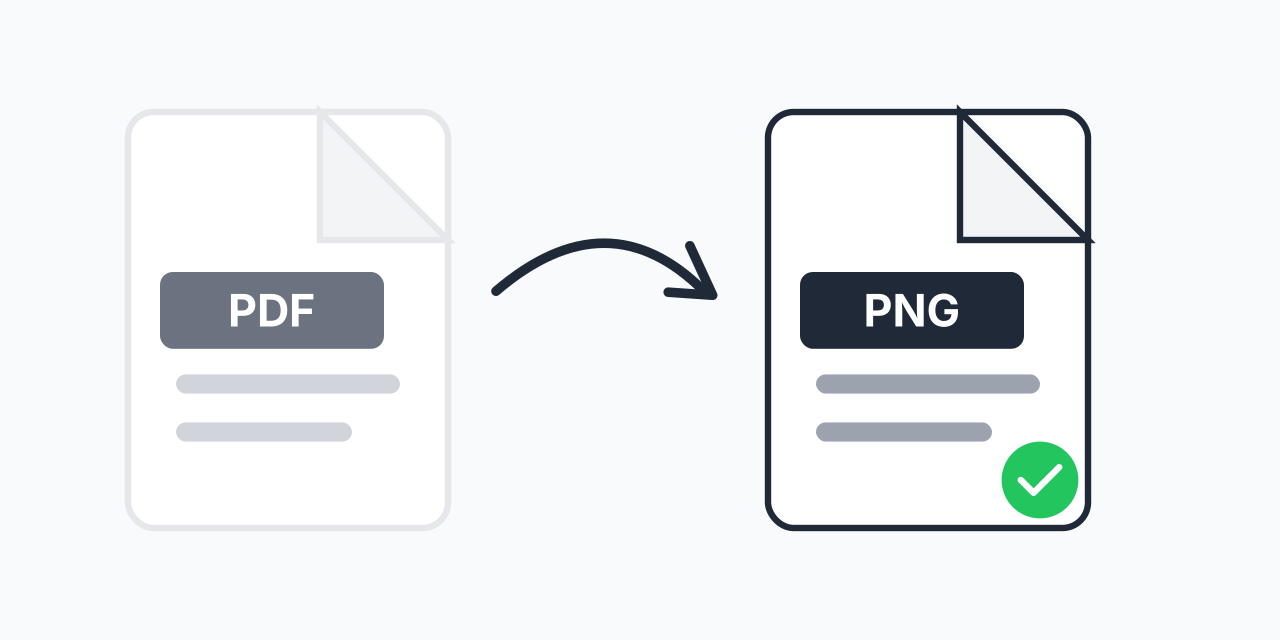
You have a PDF with charts, diagrams, or pages you need to share-but the platform doesn't accept PDFs. Social media, messaging apps, and many websites only accept image formats. Converting your PDF files to PNG solves this instantly.
PNG preserves quality through lossless compression, making it ideal for documents with text, graphics, and fine details. Unlike JPG, PNG won't introduce compression artifacts around text edges or graphic elements. In our testing, PDF pages with charts and diagrams looked noticeably sharper as PNG compared to JPG output.
How to Convert PDF to PNG
- Upload your PDF - Drag and drop or select your file
- Select PNG output - Each page converts to a separate image
- Download your images - Get high-quality PNG files ready to use
Multi-page PDFs produce multiple PNG files-one per page. No software to install, no account required.
PDF vs PNG: Understanding the Difference
PDF is a document format that can contain text, images, and vector graphics in a scalable layout. PNG is a raster image format-a grid of pixels at a fixed resolution.
When you convert PDF to PNG, you're essentially taking a snapshot of each page. The key is choosing the right resolution. Our converter produces PNG images at quality levels suitable for both screen display and printing, preserving the clarity of your original document.
When PDF Works Better
- Documents that need to be printed at various sizes
- Files with selectable, searchable text
- Multi-page documents you'll share as a single file
When PNG Works Better
- Sharing individual pages on social media or messaging
- Embedding document content in presentations or websites
- Extracting charts, diagrams, or graphics for editing
- Platforms that don't support PDF uploads
Common Use Cases
Social Media Sharing
Facebook, Instagram, Twitter, and LinkedIn don't accept PDF uploads. Convert your infographic, report page, or presentation slide to PNG and share it directly. In our testing, PNG images from PDF conversion maintained text sharpness even on high-resolution displays.
Extracting Charts and Graphics
Need that chart from page 3 of a report? Convert the PDF to PNG, and you have an image file ready for your presentation, document, or website. PNG's lossless compression ensures graphics with fine lines and small text remain crisp.
Website and Blog Content
Web pages load images, not PDFs. When you need to display document content inline-a certificate, a form preview, an infographic-PNG gives you a universal format that works in every browser.
Messaging and Email
Some email clients and messaging apps preview images inline but require downloading PDFs. Send a PNG of the relevant page for immediate visibility. Recipients see the content without opening a separate app.
Image Editing
Photo editors work with image formats, not PDFs. Converting to PNG lets you edit the document page in any image editing software-crop, annotate, add overlays, or incorporate it into larger designs.
Quality and Resolution
PDFs store content as vector graphics and embedded images at their original quality. When converting to PNG, resolution matters because you're creating a fixed-size pixel grid from scalable content.
For screen display and web use, 150 DPI typically provides excellent quality with reasonable file sizes. For printing or when fine detail matters, 300 DPI or higher preserves more clarity. In our testing, documents with small text or detailed graphics showed visible improvement at 300 DPI compared to 150 DPI output.
Our converter optimizes output quality automatically, producing PNG files that maintain the visual fidelity of your original PDF while keeping file sizes practical for sharing and storage.
Why PNG Over Other Image Formats?
When converting documents, PNG often outperforms alternatives:
- PNG vs JPG - JPG uses lossy compression that can blur text and create artifacts around sharp edges. PNG's lossless compression keeps text crisp. For documents with text and graphics, PNG is almost always the better choice.
- PNG vs TIFF - Both are lossless, but TIFF files are much larger and not universally supported by web browsers. PNG offers the same quality with smaller files and universal compatibility.
- PNG vs GIF - GIF is limited to 256 colors, making it unsuitable for photographs or complex graphics. PNG supports millions of colors with full quality.
If your PDF contains mostly photographs and file size is a priority, PDF to JPG conversion may work better. For documents with text, graphics, charts, or screenshots, PNG is the superior choice.
Multi-Page PDF Conversion
When you convert a multi-page PDF, each page becomes a separate PNG file. A 10-page document produces 10 individual images, numbered sequentially.
This is useful when you only need specific pages-convert the whole document, then use just the pages you need. For documents where you want to share everything as a single file, consider keeping the original PDF or using a format like animated GIF for short documents.
Transparency Support
PNG supports alpha transparency-backgrounds can be fully or partially transparent. However, standard PDF pages typically have a white background, so converted pages will have that white background in the PNG.
If your PDF contains graphics designed with transparency (often seen in logos or illustrations within the PDF), that transparency information may not transfer to the PNG output, as PDFs handle transparency differently than raster image formats.
Works on Any Device
Convert PDF to PNG directly in your browser:
- Windows, Mac, Linux, Chromebook
- Chrome, Firefox, Safari, Edge
- iPhone, iPad, Android tablets and phones
No downloads required. Your files stay on your device-conversion happens locally in your browser for privacy and speed.