
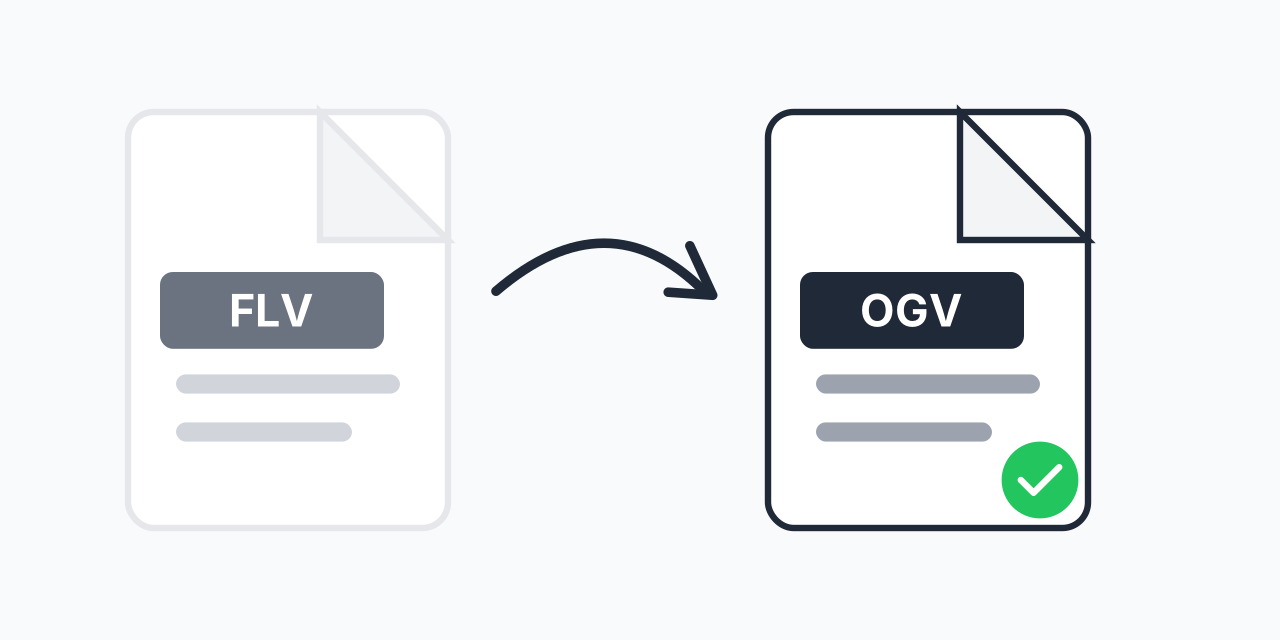
Flash Videos Need a New Home
Adobe Flash Player reached end-of-life in December 2020, leaving millions of FLV files orphaned. If you have Flash videos that won't play in modern browsers, converting to OGV solves the compatibility problem with an open, royalty-free format.
OGV uses the Theora video codec and Ogg container - both completely free to use without licensing fees. In our testing, FLV to OGV conversion preserved video quality while creating files that play natively in Firefox, Chrome, and Opera without plugins.
How to Convert FLV to OGV
- Upload your FLV file - Drag and drop or click to select your Flash video
- Select OGV as output - The converter applies optimal Theora encoding settings
- Download the converted video - Your new OGV file is ready for web use
The entire process happens in your browser. No software installation, no account registration, no file size tricks.
FLV vs OGV: Technical Comparison
Both formats are designed for web video, but they come from different eras:
- FLV (Flash Video) - Developed by Macromedia/Adobe for Flash Player. Uses Sorenson Spark or VP6 codecs. Requires plugin that no longer exists.
- OGV (Ogg Video) - Open-source format using Theora codec. Native HTML5 support. No licensing fees or patent concerns.
OGV files typically run 10-20% larger than FLV at equivalent quality because Theora prioritizes openness over cutting-edge compression. The trade-off is universal playback without any dependencies.
When to Use OGV Format
Open Source Projects
OGV is the only video format that's completely free from patent claims. If you're distributing video with open-source software, OGV ensures no licensing complications.
Firefox-Focused Websites
Firefox has historically prioritized OGV support. While modern Firefox also plays WebM and MP4, OGV remains reliable for maximum compatibility with privacy-focused Firefox users.
Archival and Preservation
Open formats are safer for long-term archival. Unlike proprietary codecs that may require future licensing, Theora/OGV will always be freely usable.
Alternative Formats to Consider
OGV isn't always the optimal choice. Consider these alternatives:
- FLV to WebM - Better compression than OGV, also royalty-free. Best for most web use cases.
- FLV to MP4 - Universal playback including iOS/Safari. Best for maximum device compatibility.
- FLV to MKV - Container format for archival with multiple streams. Best for preserving everything.
Choose OGV specifically when open-source licensing matters or when targeting platforms that prefer Ogg formats.
Quality and Settings
Our converter uses sensible Theora encoding defaults that balance file size and quality. In our testing with typical FLV content (480p screen recordings, web videos), the output maintained visual quality comparable to the source.
Theora performs best with lower resolution content. For 1080p or 4K video, WebM with VP9 codec offers better efficiency. OGV shines for standard definition web video where openness matters more than bleeding-edge compression.
Works on Any Device
Convert FLV to OGV directly in your browser:
- Windows, Mac, Linux, Chromebook
- Chrome, Firefox, Safari, Edge
- Tablets and smartphones
No downloads, no plugins (ironic, given we're converting from a plugin-dependent format), no waiting for installation.