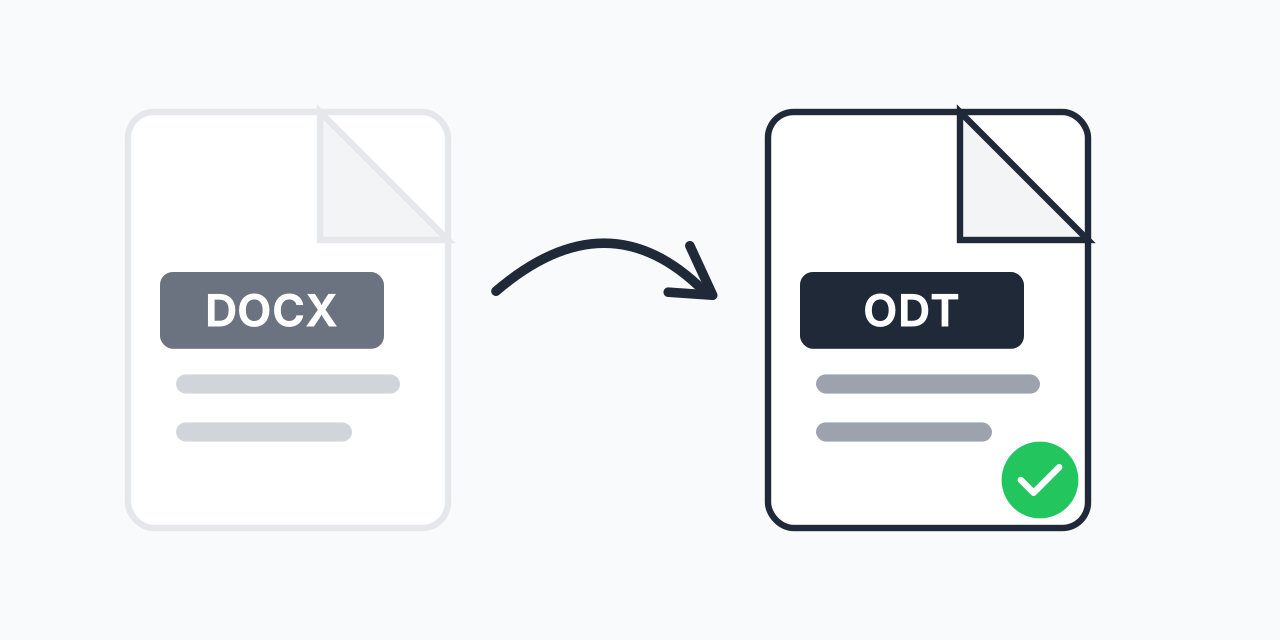
Why Convert DOCX to ODT?
You have Word documents but prefer working in LibreOffice or OpenOffice. Or maybe your organization requires open format documents for compliance. Either way, converting DOCX files to ODT gives you full editing capability in free office software without paying for Microsoft Office licenses.
ODT (OpenDocument Text) is the native format for LibreOffice Writer and Apache OpenOffice Writer. While these programs can open DOCX files, saving in ODT ensures perfect compatibility and access to all features. In our testing, documents converted to ODT maintain their formatting while gaining full editability in open-source office suites.
How to Convert DOCX to ODT
- Upload your DOCX file - Drag and drop or click to select your Word document
- Confirm ODT output - ODT is selected for OpenDocument compatibility
- Download your file - Open in LibreOffice, OpenOffice, or any ODF-compatible application
The conversion happens in your browser. No software installation, no account required, no file size waiting.
What Gets Preserved
In our testing, DOCX to ODT conversion maintains the elements that matter most for document editing:
- Text and paragraphs - All content transfers intact with paragraph styles
- Formatting - Bold, italic, underline, colors, and font choices remain
- Tables - Standard tables convert cleanly with cell formatting preserved
- Images - Embedded pictures maintain position and sizing
- Lists - Bullets and numbered lists keep their structure
- Headers and footers - Page structure elements transfer correctly
- Footnotes and endnotes - References maintain their links
For typical business documents, reports, and academic papers, the conversion is seamless. You will not notice a difference in appearance.
What May Change
Some advanced Word-specific features behave differently in ODT format. In our testing, these are the main considerations:
- Track Changes - Revision history gets accepted and flattened in ODT. Save your final version or export tracked changes before converting
- Macros and VBA - Word macros do not transfer. LibreOffice uses a different scripting system
- SmartArt - Complex graphics convert to basic shapes, losing interactive editing
- Document themes - Theme-based formatting converts to direct formatting
- Complex tables - Tables exceeding 64 columns may need adjustment
For standard text documents, these limitations rarely matter. If your document relies heavily on macros or SmartArt, consider whether ODT suits your workflow.
Who Uses ODT Format
Government Agencies
Many governments mandate open formats for public documents. The UK civil service uses ODF as standard. NATO requires ODF for documents shared among its 26 member nations. The European Union recommends open formats for public sector documents.
Educational Institutions
Schools and universities using LibreOffice need documents in ODT format. Students working on shared projects benefit from format consistency. Budget-conscious institutions save thousands by avoiding Microsoft Office licenses.
Open Source Advocates
Privacy-conscious users prefer ODT because it is an ISO international standard (ISO/IEC 26300). Your documents remain accessible regardless of which company controls the software market. No vendor lock-in means freedom to switch applications anytime.
Cost-Conscious Organizations
LibreOffice is free. For organizations with hundreds of users, switching from Microsoft Office to LibreOffice saves substantial licensing costs. Converting existing DOCX archives to ODT completes the transition.
ODT vs DOCX: Format Comparison
| Feature | DOCX | ODT |
|---|---|---|
| Native application | Microsoft Word | LibreOffice Writer, OpenOffice Writer |
| Standard | ECMA-376 / ISO 29500 | OASIS / ISO 26300 |
| License cost | Requires Office license | Free with LibreOffice |
| Cross-platform | Best on Windows | Equal on Windows, Mac, Linux |
| Long-term access | Depends on Microsoft | Open standard, future-proof |
| File size | Typically larger | Often smaller |
Both formats are XML-based and store documents as compressed archives. The key difference is ecosystem: DOCX ties you to Microsoft, while ODT works with any ODF-compliant application.
Alternative Conversions
Depending on your needs, other formats might serve you better:
- DOCX to PDF - When you need to share documents without allowing editing
- DOCX to TXT - When you only need the text content without formatting
- DOCX to RTF - For maximum compatibility with older word processors
- DOCX to HTML - For web publishing or email content
If you receive ODT files and need them in Word format, you can also convert ODT files back to DOCX.
Batch Conversion
Migrating an entire document library from Word to LibreOffice? Upload multiple DOCX files and convert them all to ODT at once. In our testing, batch conversion maintains the same quality as individual file conversion. This is particularly useful for organizations standardizing on open formats.
Works on Any Device
Convert DOCX to ODT directly in your browser:
- Windows, Mac, Linux, Chromebook
- Chrome, Firefox, Safari, Edge
- iPhone, iPad, Android tablets
No downloads, no plugins, no Java required. If your browser runs JavaScript, you can convert files.