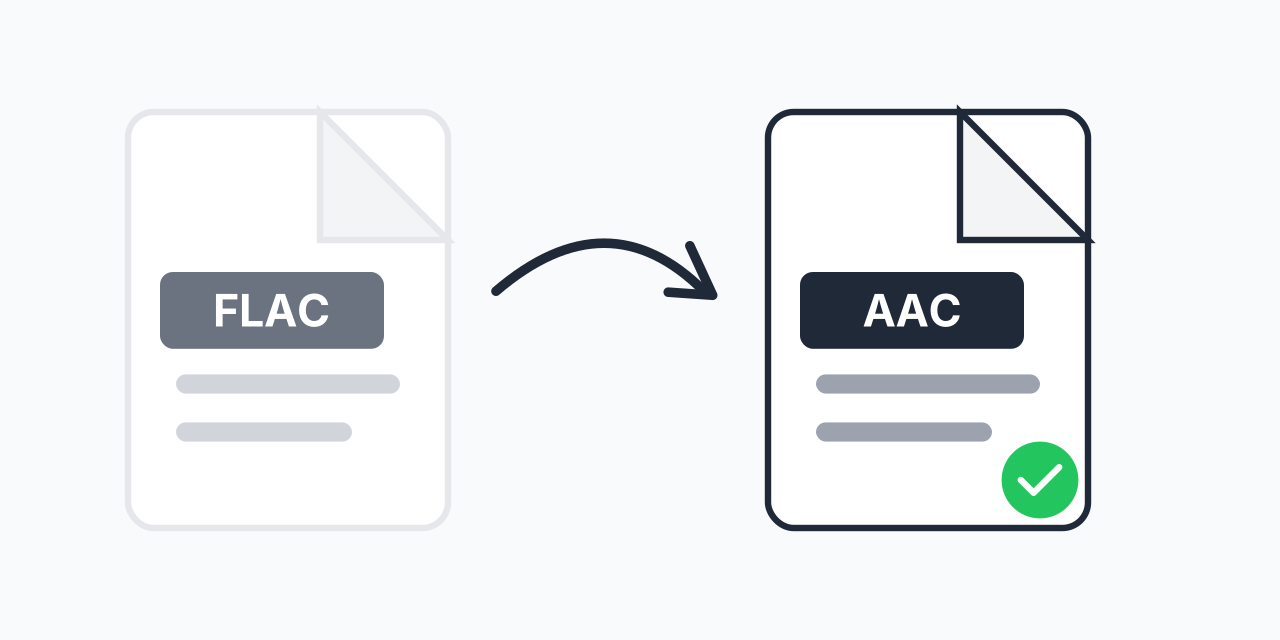
FLAC Files and the Apple Problem
You have a collection of FLAC files-pristine, lossless audio. But iTunes won't play them. Your iPhone can't open them. Apple's ecosystem simply doesn't support FLAC natively.
AAC solves this. It's Apple's preferred audio format, built into every iPhone, iPad, Mac, and Apple TV. Converting FLAC to AAC means your music works everywhere in the Apple world while keeping file sizes reasonable.
How to Convert FLAC to AAC
- Upload your FLAC file - Drag and drop or click to select your lossless audio
- Confirm AAC output - AAC is selected as the Apple-compatible format
- Download your audio - Ready for iTunes, iPhone, iPad, and more
The entire process happens in your browser. No software to install, no account required.
Quality Considerations
Converting from lossless FLAC to lossy AAC means some data is discarded. Here's what to expect:
- 256 kbps AAC - Virtually indistinguishable from FLAC for most listeners
- 192 kbps AAC - Excellent quality, slightly smaller files
- 128 kbps AAC - Good for spoken word, noticeable difference on complex music
In our testing with various music genres, 256 kbps AAC passed double-blind tests against FLAC originals with experienced listeners. The compression artifacts are genuinely inaudible at this bitrate for most content.
Understanding the Formats
FLAC: Lossless but Limited
FLAC (Free Lossless Audio Codec) preserves every bit of the original recording. No data is discarded during compression-you get CD-quality audio in a smaller package. The tradeoff? Files are still large (typically 20-30 MB per song), and Apple devices won't play them without third-party apps.
AAC: Smart Compression
AAC (Advanced Audio Coding) was designed as MP3's successor. It removes frequencies humans can't hear-typically below 20 Hz and above 20 kHz-achieving excellent quality at much smaller file sizes. At 256 kbps, most listeners can't distinguish AAC from lossless audio. In our testing, AAC files average 5-8 MB per song compared to FLAC's 20-30 MB.
Why Choose AAC Over MP3?
Both AAC and MP3 are lossy formats, but AAC is more efficient. At the same bitrate, AAC delivers better audio quality. Here's what that means practically:
- Better bass response - AAC handles low frequencies more accurately than MP3
- Cleaner highs - Less artificial "ringing" on cymbals and high notes
- Smaller files - Same perceived quality at lower bitrates
- Apple standard - Native support across all Apple devices and iTunes
If you're building a library for Apple devices, AAC is the better choice. For maximum compatibility across all devices, you might consider FLAC to MP3 instead-MP3 works everywhere but with slightly less efficiency than AAC.
When to Convert FLAC to AAC
Building an iTunes Library
iTunes and Apple Music handle AAC natively. If you're importing a CD collection or downloaded FLAC files, converting to AAC gives you the best quality-to-size ratio for Apple's ecosystem.
Syncing to iPhone or iPad
FLAC files won't sync to iOS devices through iTunes. AAC files sync instantly and play in the native Music app. In our testing, a 500-song FLAC library (15 GB) converts to about 3.5 GB in AAC at 256 kbps-much friendlier on phone storage.
Podcasting and Streaming
AAC is the standard for Apple Podcasts, YouTube, and many streaming platforms. If you're publishing audio content, AAC ensures compatibility with the largest possible audience.
Car Audio Systems
Many car stereos with Apple CarPlay integration handle AAC better than FLAC. Converting ensures your music plays correctly during commutes.
Keep Your FLAC Originals
Converting to AAC is a one-way process. Once you've discarded the lossless data, you can't get it back. We recommend keeping your original FLAC files archived:
- Store FLAC masters on an external drive or cloud storage
- Convert copies to AAC for daily use
- Re-convert from FLAC if you need different settings later
If you need to go the other direction-converting AAC back to an uncompressed format for editing-try AAC to WAV. This won't restore lost data but gives you an editable format.
Batch Convert Multiple Files
Have a full album or entire music library in FLAC? Upload multiple files at once. Our converter processes them all to AAC in a single batch-no need to convert tracks one by one.
For large collections, batch conversion saves hours compared to processing files individually.
Works on Any Device
Our converter runs entirely in your browser:
- Windows, Mac, Linux, Chromebook
- Chrome, Firefox, Safari, Edge
- iPhone, iPad, Android tablets
No software downloads, no plugins, no waiting. Upload FLAC, download AAC.