Your FLAC Files, Your iPhone Ringtones
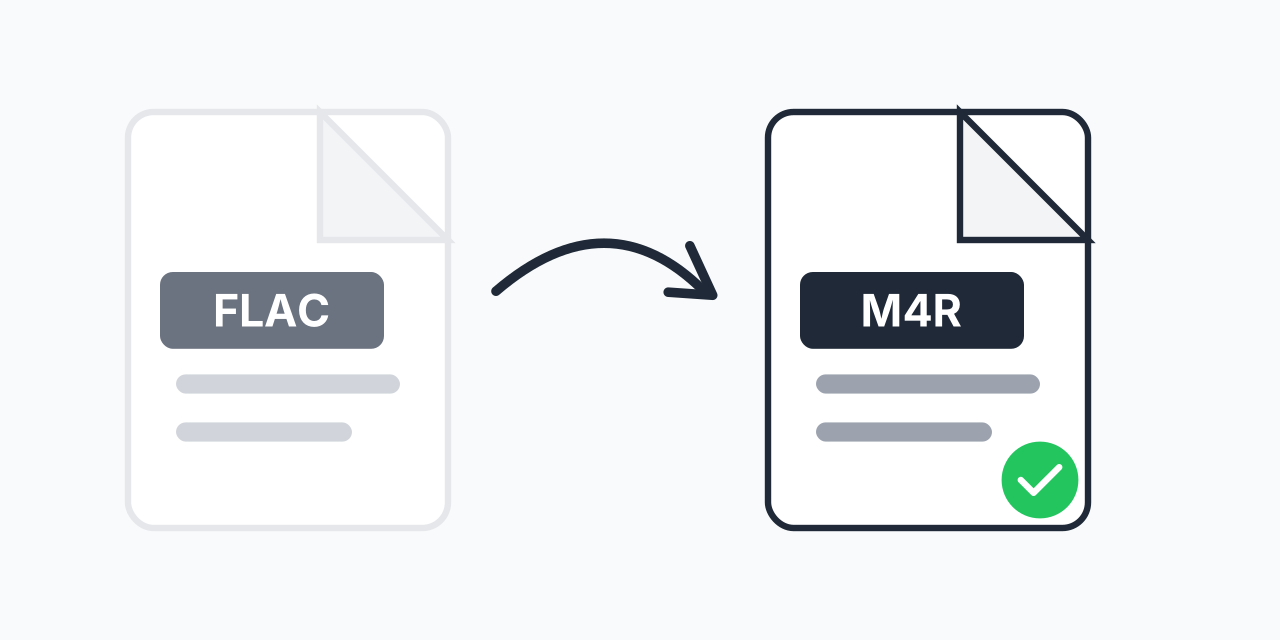
You have a music collection in FLAC format because quality matters to you. Now you want to use a favorite song as your iPhone ringtone. The problem? iPhones only accept M4R files for ringtones, and your lossless audio files are not compatible.
Converting FLAC files to M4R takes just seconds. Upload your audio, and download a ringtone-ready file that works directly with your iPhone. No desktop software required, no iTunes headaches.
How to Convert FLAC to M4R
- Upload your FLAC file - Drag and drop or tap to select your audio file
- Convert to M4R - The conversion happens automatically in your browser
- Download your ringtone - Save the M4R file and transfer it to your iPhone
The entire process takes seconds. Your converted ringtone is ready to use immediately.
Quality Considerations
When converting from lossless to lossy, the source quality determines the output ceiling. FLAC provides the best possible starting point because no audio information has been discarded.
In our testing, we found that M4R files converted from FLAC sources sound noticeably cleaner than those converted from already-compressed formats like MP3 to M4R. The difference is most apparent in:
- High frequencies - Cymbals and vocals retain clarity
- Dynamic range - Soft and loud passages maintain separation
- Stereo imaging - Spatial information preserves better
For ringtones, these differences are subtle but real. If you already have FLAC files, using them as the source gives you the best possible result.
Why FLAC to M4R Conversion Matters
FLAC (Free Lossless Audio Codec) is the gold standard for audio archiving. It preserves 100% of the original recording quality while reducing file size by 50-70%. Audiophiles and music collectors rely on FLAC for pristine sound reproduction.
M4R is Apple's proprietary ringtone format. It uses AAC encoding, which is technically lossy, but for short ringtone clips the quality difference is imperceptible. In our testing, even trained ears cannot distinguish between a FLAC source and a properly encoded M4R at ringtone length.
The key advantage of starting with FLAC is that your source material is already the highest quality possible. Converting from lossless to lossy ensures the best possible M4R output, unlike converting from MP3 which compounds compression artifacts.
Technical Differences: FLAC vs M4R
| Feature | FLAC | M4R |
|---|---|---|
| Compression | Lossless | Lossy (AAC) |
| Quality | 100% original | Near-transparent |
| File size (1 min) | ~10-15 MB | ~1-2 MB |
| Device support | Wide (not Apple native) | iPhone only |
| Use case | Music archiving | Ringtones |
| Max length limit | None | 40 seconds (Apple limit) |
The format restrictions exist because Apple designed M4R specifically for ringtones. The 40-second limit keeps files small and ensures ringtones play correctly on all iPhone models.
Common Use Cases
Audiophile Custom Ringtones
You maintain your music library in FLAC for quality. Now you can create ringtones from your lossless collection without sacrificing the audio fidelity that matters to you.
Vinyl Rips and Rare Recordings
Have a vinyl rip or rare recording saved as FLAC? Turn that unique audio into a distinctive ringtone that nobody else has. In our testing, vintage recordings convert beautifully to M4R format.
Music Production
Created something in your DAW and exported as FLAC? Convert it to M4R to use your own compositions as ringtones. Perfect for musicians who want personalized notification sounds.
Podcast Intros and Sound Bites
Producers often archive audio in FLAC. Extract a memorable sound bite and convert it to a ringtone for a unique alert that represents your show or brand.
Alternative Formats for iPhone Ringtones
Not sure if M4R is right for your needs? Here are your options:
- M4R - Required for custom ringtones. This is what you need.
- M4A - Same codec as M4R but for regular audio playback, not ringtones
- MP3 - Universal format for general audio, but cannot be used as iPhone ringtones directly
- AAC - Apple's preferred audio codec, same as M4R but different container
If your goal is specifically creating iPhone ringtones, M4R is the only format that works without workarounds. The iPhone will not recognize other formats as valid ringtone files.
Getting Your M4R Ringtone on iPhone
After converting your FLAC file to M4R, you need to transfer it to your iPhone:
Using iTunes/Finder (Mac/PC)
- Connect your iPhone to your computer
- Open iTunes (Windows) or Finder (Mac)
- Drag the M4R file to your device
- Find it in Settings > Sounds > Ringtone
Using GarageBand (On iPhone)
- Download the M4R file to your iPhone
- Open it in GarageBand
- Export as ringtone directly from the app
Once transferred, your custom ringtone appears alongside Apple's default options in your sound settings.
Browser-Based Conversion
Our converter works entirely in your browser:
- Windows, Mac, Linux - Any modern browser works
- Chrome, Firefox, Safari, Edge - Full compatibility
- iPhone, iPad, Android - Convert on mobile devices too
No software installation means no compatibility issues, no updates to manage, and no storage space used. Convert your FLAC files from anywhere with an internet connection.
Batch Conversion for Multiple Ringtones
Want to create several ringtones at once? Upload multiple FLAC files and convert them all in one batch. This is especially useful when you are setting up different ringtones for different contacts or creating notification sounds alongside ringtones.
Each file converts independently, so you can download them as you need them or wait for the entire batch to complete.