Large FLAC Files Eating Your Storage?
FLAC files sound incredible but they're massive. A single album can easily exceed 500MB, and your phone or music player fills up fast. Meanwhile, streaming services and web applications often can't even play FLAC files.
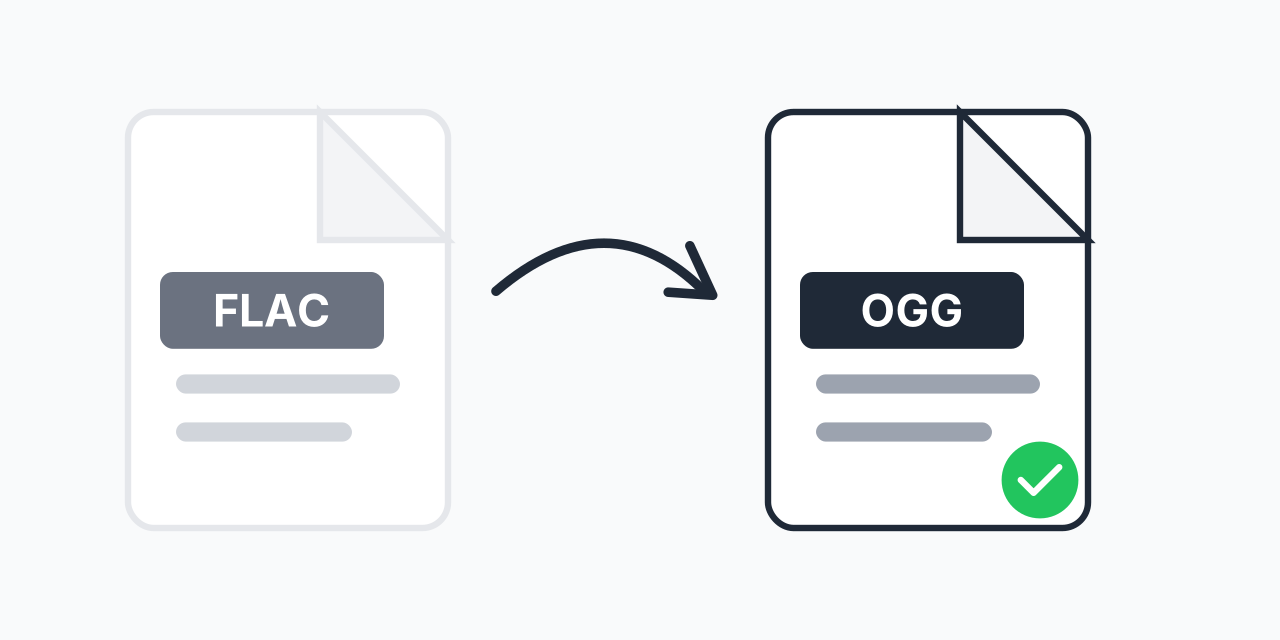
OGG Vorbis solves both problems. It compresses FLAC files by up to 80% while maintaining audio quality that most listeners can't distinguish from the original. In our testing, a 40MB FLAC track typically converts to around 8MB in OGG format at high quality settings.
How to Convert FLAC to OGG
- Upload your FLAC file - Drag and drop or click to select your lossless audio
- Confirm OGG output - Our converter automatically applies optimal quality settings
- Download your OGG file - Get your compressed audio ready for any use
The entire process happens in your browser. No software installation, no account creation, no waiting in queues.
Quality Considerations
Converting from lossless to lossy is a one-way process. Once audio data is removed during OGG encoding, it cannot be recovered. That's why we recommend keeping your original FLAC files as archives.
For the best results, convert directly from FLAC rather than from another lossy format like MP3. Starting with lossless audio ensures OGG has the highest quality source material to work with. If you need a different lossy format instead, consider FLAC to MP3 for maximum device compatibility.
In our testing with various audio genres, OGG Vorbis at quality level 6 (roughly 192 kbps) provides excellent results for most music. For critical listening or complex orchestral pieces, quality level 8-10 (256-320 kbps) is virtually transparent.
FLAC vs OGG: Understanding the Tradeoff
FLAC (Free Lossless Audio Codec) preserves every bit of audio data from the original recording. It's the archival standard used by audiophiles and music producers who need perfect reproduction.
OGG Vorbis takes a different approach. It analyzes audio and removes frequencies that human ears typically can't perceive, achieving dramatic file size reduction. At 320 kbps, OGG Vorbis is transparent for most listeners - meaning even trained ears struggle to distinguish it from lossless audio.
The key difference: FLAC bitrates range from 700-1100 kbps while OGG operates at 45-500 kbps. That's why OGG files are so much smaller while still sounding excellent.
When to Convert FLAC to OGG
Mobile Music Libraries
Smartphones have limited storage. In our testing, converting a 10GB FLAC music collection to OGG at high quality reduced it to under 2GB while maintaining audio quality that's indistinguishable during normal listening - walking, commuting, exercising.
Web Audio and Streaming
OGG Vorbis was designed for streaming. Spotify uses it for their premium tier because it delivers high quality at manageable file sizes. If you're building a website or app with audio, OGG loads faster than FLAC.
Gaming and Applications
Video games commonly use OGG for soundtracks and audio effects. It's patent-free, open-source, and supported natively on Android, Linux, and most game engines. Converting your FLAC audio to OGG ensures compatibility.
Sharing Music
Sending a FLAC album means transferring hundreds of megabytes. The same album in OGG fits in a fraction of the space, making it practical to share via email, messaging apps, or cloud storage with limited space.
Compatibility Guide
OGG Vorbis has excellent support on open platforms:
- Android - Native support on all Android devices
- Linux - Works out of the box on every Linux distribution
- Windows - VLC, foobar2000, and most media players support OGG
- Web browsers - Chrome, Firefox, Edge, and Opera play OGG natively
- macOS - Requires VLC or similar player (not native to iTunes)
- iOS - Requires third-party apps like VLC for Mobile
Note that Apple devices don't natively support OGG. If you primarily use iPhone or iTunes, consider FLAC to M4A instead for better Apple ecosystem compatibility.
Why OGG Over Other Formats?
OGG Vorbis offers several advantages over MP3, which dominated portable audio for decades:
- Better efficiency - OGG sounds better than MP3 at the same bitrate
- No patents - Completely free and open-source, unlike MP3 which had licensing restrictions until 2017
- Superior handling of complex audio - In our testing, OGG preserves transients and subtle reverb details better than MP3 at equivalent bitrates
- Native streaming support - Designed from the ground up for network audio
For modern applications, OGG Vorbis hits the sweet spot between quality, file size, and open standards. The only reason to choose MP3 is compatibility with legacy devices.
Batch Conversion
Have an entire music library in FLAC? Upload multiple files and convert them all to OGG at once. This is particularly useful when preparing music for a portable player or when migrating your collection to a device with limited storage. Our batch conversion maintains consistent quality settings across all files.
Browser-Based Processing
Your audio files are processed entirely in your browser using modern web technologies. This means:
- Your music never leaves your device during conversion
- No file size limits imposed by server uploads
- Fast conversion without queue waiting times
- Works on Windows, Mac, Linux, and even mobile devices
Whether you're converting a single track or your complete music library, the process remains private and efficient.