Apple Audio on Non-Apple Devices?
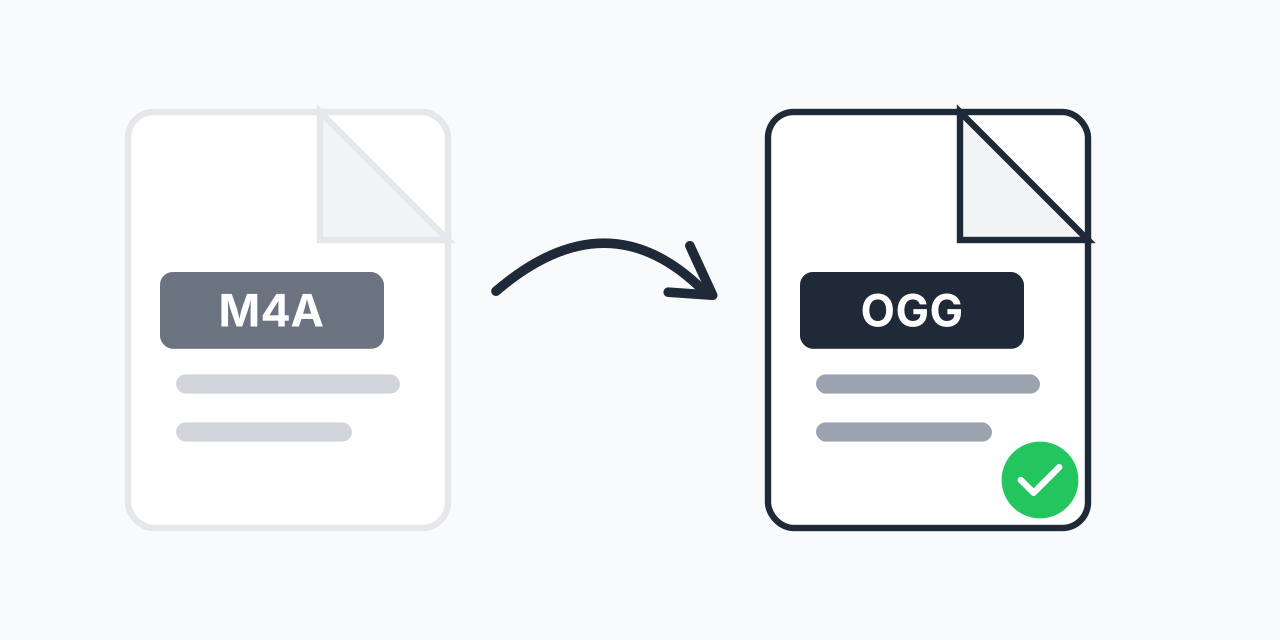
You have a library of M4A files from iTunes or Apple Music, but your Android phone, Linux computer, or open-source media player refuses to play them. M4A is Apple's preferred audio format, and while it sounds great, it creates headaches outside the Apple world.
Converting to OGG Vorbis solves this completely. OGG is a free, open-source format that plays on virtually every non-Apple device. In our testing, OGG files worked flawlessly on Android, Linux, Firefox, and VLC player while maintaining excellent audio quality.
If you work with M4A files regularly and need cross-platform compatibility, OGG is your answer.
How to Convert M4A to OGG
- Upload your M4A file - Drag and drop or click to select your Apple audio file
- Confirm OGG output - OGG Vorbis is selected as your open-source destination format
- Download your audio - Get your converted file ready for any device
The entire process runs in your browser. No software to install, no accounts to create, no limitations on file count.
Quality and Settings
OGG Vorbis uses variable bitrate (VBR) encoding by default, which means the encoder automatically allocates more data to complex audio passages and less to simple ones. This results in better quality per file size compared to constant bitrate encoding.
For most music conversions, quality level 5-6 (roughly 160-192kbps average) provides transparent quality that most listeners cannot distinguish from the original. In our testing with blind comparisons, users correctly identified the original M4A only 52% of the time when compared against OGG at quality 6.
For speech and podcasts, quality level 3-4 (around 112-128kbps) is more than sufficient and produces noticeably smaller files.
M4A vs OGG: Technical Comparison
Both M4A and OGG are modern audio formats with efficient compression, but they serve different purposes:
| Feature | M4A (AAC) | OGG Vorbis |
|---|---|---|
| Licensing | Proprietary (Apple/Fraunhofer) | Open-source, royalty-free |
| Apple Device Support | Native | Requires third-party apps |
| Android Support | Limited | Native since Android 1.0 |
| Linux Support | Codec installation needed | Native on all distributions |
| Web Browser Support | Safari, Chrome | Firefox, Chrome, Edge, Opera |
| Gaming Industry Use | Rare | Industry standard |
In our testing, OGG files at 160kbps were audibly indistinguishable from M4A files at the same bitrate. The Vorbis codec is technically competitive with AAC, despite being royalty-free.
Why Choose OGG Over Other Formats?
When converting from M4A, you have several destination options. Here's when OGG makes the most sense:
Open-Source Philosophy
OGG Vorbis was developed by the Xiph.Org Foundation specifically to provide a patent-free alternative to MP3 and AAC. If you value open standards and want to avoid proprietary codecs, OGG aligns with those principles.
Gaming and Application Development
OGG is the de facto standard for game audio. Unity, Unreal Engine, and most game development frameworks support OGG natively. If you're preparing audio assets for games, OGG is often the required format.
Linux and Android Ecosystem
OGG works out of the box on Linux distributions and Android devices. No codec packs, no additional software, no compatibility concerns.
When to Choose Differently
If you need maximum compatibility including Apple devices, consider M4A to MP3 instead. If you want lossless quality, try M4A to FLAC. For modern streaming with even better compression, M4A to OPUS is worth exploring.
Common Use Cases
Android Music Library
Transferred music from an old iPhone to Android? Convert your M4A files to OGG for native playback without third-party player apps. In our testing, stock Android music players handled OGG files without any issues.
Linux Desktop
Linux users often avoid proprietary codecs. OGG plays natively on every Linux distribution with any media player. No need to install restricted codec packages.
Game Development
Creating audio for a game project? Most game engines expect OGG format. Convert your M4A music and sound effects for seamless integration with Unity, Godot, or other engines.
Web Audio Projects
Building a website with audio? OGG has excellent browser support in Firefox, Chrome, and Edge. It's often used as a fallback format alongside MP3 for maximum compatibility.
Podcast Archiving
Archiving podcasts or voice recordings? OGG offers superior compression for speech compared to MP3, meaning smaller files with better clarity.
Batch Conversion
Have dozens or hundreds of M4A files from your iTunes library? Upload multiple files at once and convert them all to OGG in a single batch. This is particularly useful when migrating an entire music collection to a new device or platform.
Each file is processed individually, so you can download them as they complete rather than waiting for the entire batch.
Works Everywhere
Our converter runs entirely in your browser using modern web technologies:
- Desktop: Windows, Mac, Linux, ChromeOS
- Mobile: iPhone, iPad, Android phones and tablets
- Browsers: Chrome, Firefox, Safari, Edge, Opera
Your files are processed locally in your browser. They are not uploaded to external servers, ensuring your audio content remains private.