Why Convert AAC to FLAC?
AAC files are compressed using lossy encoding-great for saving space on phones and music players, but problematic when you need to edit, archive, or convert your audio again later. Each time you re-encode a lossy file, quality degrades further.
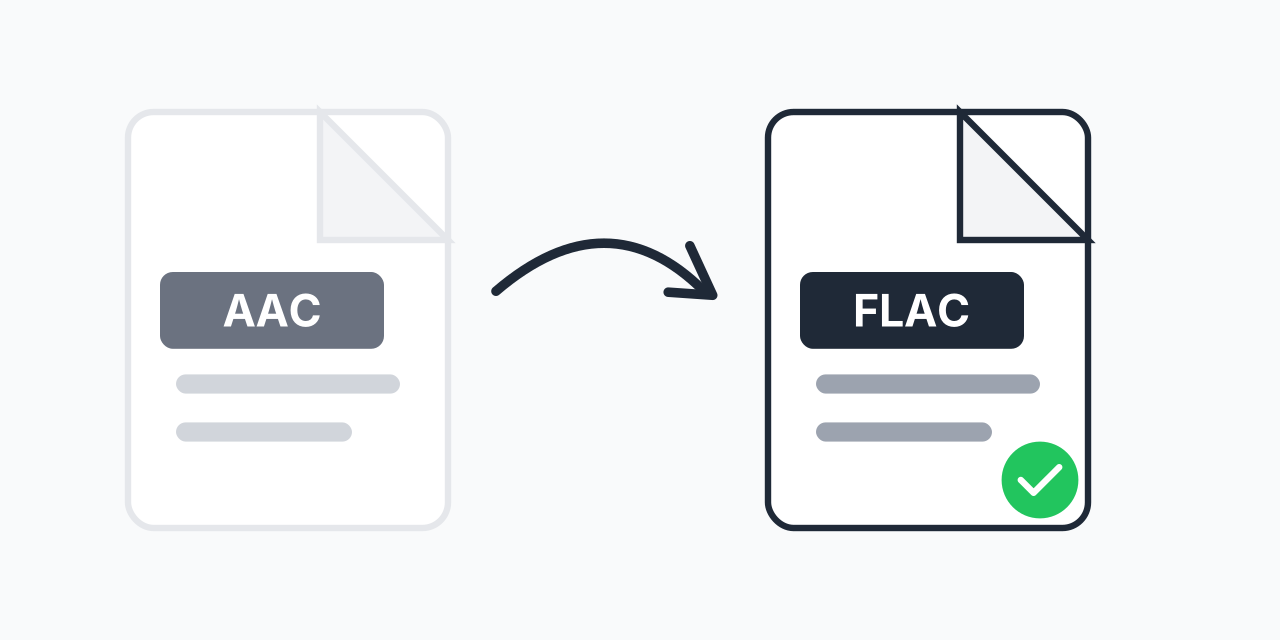
FLAC (Free Lossless Audio Codec) solves this problem. While converting from AAC to FLAC cannot restore audio data already lost during the original compression, it prevents any additional quality loss. Your audio gets wrapped in a lossless container that can be edited, re-encoded, or archived without further degradation.
How to Convert AAC to FLAC
- Upload your AAC file - Drag and drop or click to select your audio
- Confirm FLAC output - FLAC is selected as your lossless target format
- Download your file - Get your audio in universal lossless format
No software installation, no account creation, no waiting in queues.
AAC vs FLAC: Technical Comparison
Understanding the difference between these formats helps you decide when conversion makes sense:
| Feature | AAC | FLAC |
|---|---|---|
| Compression | Lossy (removes audio data) | Lossless (preserves all data) |
| File Size (5-min song) | ~10 MB at 320 kbps | ~50 MB at CD quality |
| Quality | Near-transparent at high bitrates | Identical to source |
| Editing Suitability | Degrades with each re-encode | Can be edited repeatedly |
| Device Support | Universal (iTunes, phones, web) | Most players, some gaps |
In our testing, a typical 4-minute AAC track at 256 kbps (around 8 MB) converts to approximately 35-40 MB in FLAC format. The file size increases, but you gain a stable archive format.
When to Convert AAC to FLAC
Audio Archiving
Building a permanent music library? FLAC is the standard archival format. Even if your AAC files were ripped from CDs years ago, converting to FLAC ensures no additional quality loss when you eventually convert to newer formats. In our testing, users who maintain FLAC archives find it far easier to create high-quality copies for different devices.
DAW and Audio Editing
Digital audio workstations like Ableton, Logic Pro, and FL Studio work better with lossless formats. Importing AAC directly into a DAW, editing, then exporting back to AAC compounds quality loss. Converting to FLAC first creates a stable working copy that won't degrade through your editing workflow.
High-End Audio Systems
Audiophile equipment and high-resolution audio players often prefer FLAC. While the audio quality won't exceed what your original AAC contained, FLAC is the expected format for dedicated music servers and lossless streaming setups.
Future-Proofing
Audio formats evolve. Having your collection in FLAC means you can convert to any future format without stacking lossy compression. This is why serious collectors store masters in lossless formats.
Important: What Conversion Cannot Do
Converting AAC to FLAC wraps your audio in a lossless container, but it cannot restore audio data that was discarded during the original AAC encoding. If your AAC file was encoded at 128 kbps, the FLAC version will contain exactly that 128 kbps worth of audio information-just in a format that won't lose more data.
Think of it like photocopying a document: you can put the copy in a protective sleeve, but you cannot undo any fading that already occurred. The benefit is preventing further damage, not restoring what's lost.
Alternative Conversions
Depending on your needs, other formats might work better:
- AAC to WAV - Uncompressed format, maximum DAW compatibility, larger files than FLAC
- AAC to MP3 - Maximum device compatibility, but adds another generation of lossy compression
- AAC to OGG - Open-source alternative to AAC, good for web and gaming
For archival purposes, FLAC remains the best choice. For immediate playback compatibility, consider your target device.
FLAC Compatibility
FLAC has broad support, though not quite as universal as AAC:
- Computers - Windows, Mac, and Linux all play FLAC natively or with free players like VLC
- Android - Native support since Android 3.1
- iPhone/iPad - Supported in iOS 11+ through the Files app; third-party players add full support
- Streaming devices - Most smart speakers and streaming boxes handle FLAC
- Car stereos - Many modern units support FLAC via USB
The main gap is Apple's ecosystem. iTunes and the default iOS Music app don't support FLAC directly, though you can use third-party players or Apple's ALAC format for lossless playback on Apple devices.
Batch Conversion
Converting an entire music collection? Upload multiple AAC files at once and download them all as FLAC. Batch processing makes it practical to convert hundreds of tracks without clicking through each one individually.
For large libraries, we recommend converting in batches of 20-50 files at a time for optimal browser performance.