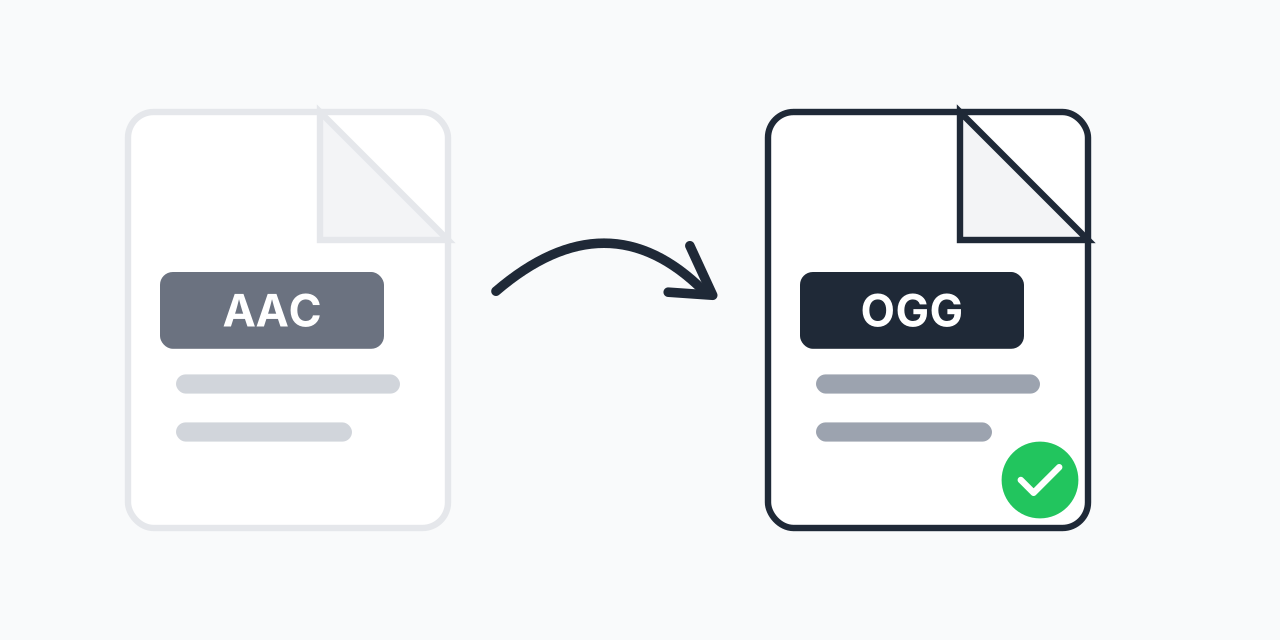
Why Convert AAC to OGG?
AAC is Apple's preferred audio format-great on iPhones and iTunes, but problematic elsewhere. If you're building a game, creating web content, or working on open-source projects, AAC's licensing requirements become a real obstacle.
OGG Vorbis is the solution. Developed by the Xiph.Org Foundation, it's completely patent-free and royalty-free. You can use it in commercial projects without licensing fees or legal concerns. In our testing, OGG files at equivalent quality settings were about 15-20% smaller than AAC while maintaining excellent audio fidelity.
Whether you have AAC files from Apple Music, voice recordings, or extracted audio tracks, converting to OGG opens doors that AAC keeps closed.
How to Convert AAC to OGG
- Upload your AAC file - Drag and drop or click to select your audio
- Confirm OGG output - OGG Vorbis is selected as your target format
- Download your file - Get your patent-free audio ready for any use
No software installation, no account creation, no waiting. Your audio converts in seconds.
Quality and Settings
When converting AAC to OGG, quality depends on your source file. In our testing with 256 kbps AAC files, the resulting OGG maintained excellent quality-indistinguishable from the original in casual listening.
OGG Vorbis uses a quality scale from -1 to 10:
- Quality 3 (~112 kbps) - Good for voice and podcasts
- Quality 5 (~160 kbps) - Transparent for most music
- Quality 7 (~224 kbps) - High fidelity, hard to distinguish from lossless
- Quality 10 (~500 kbps) - Maximum quality, larger files
Since both AAC and OGG are lossy formats, transcoding does introduce some theoretical quality loss. For best results, use the highest quality AAC source available. If you need perfect preservation, consider converting your original source to lossless FLAC instead.
AAC vs OGG: Technical Comparison
Both formats use lossy compression, but they serve different purposes:
- Licensing - AAC requires patent licenses for encoding/decoding. OGG is completely free and open-source.
- Quality at low bitrates - In our testing, OGG Vorbis maintains better clarity below 128 kbps. AAC shows more compression artifacts at these rates.
- Compatibility - AAC dominates Apple devices. OGG dominates gaming engines, Linux systems, and web applications.
- File size - At matched quality levels, OGG typically produces slightly smaller files.
- Browser support - OGG plays natively in Firefox, Chrome, and Edge via HTML5 audio. Safari prefers AAC.
The codec behind OGG Vorbis uses modified discrete cosine transform (MDCT) compression, supporting sample rates from 8 kHz up to 192 kHz and channel configurations from mono to 7.1 surround sound.
Who Needs AAC to OGG Conversion?
Game Developers
OGG has been the gaming industry standard for decades. Unreal Engine, Unity, and countless other game engines use OGG natively. Major titles from Halo to Unreal Tournament ship with OGG audio. If you're developing games, converting your AAC sound effects and music to OGG avoids licensing headaches entirely.
Web Developers
Building HTML5 audio players? OGG works in most browsers without plugins. The WebM project-Google's open media format-uses Vorbis audio. For web projects targeting Firefox and Chrome users, OGG is the reliable choice.
Open-Source Projects
If you're contributing to or building open-source software, patent-encumbered formats like AAC create distribution problems. OGG lets you include audio without legal complications.
Linux Users
Linux distributions favor open formats. While AAC playback requires additional codecs, OGG plays out of the box on virtually every Linux system.
When to Choose a Different Format
OGG isn't always the answer. Here's when alternatives make more sense:
- Apple ecosystem - If your audio stays on Apple devices, keep it as AAC. Converting adds no benefit.
- Maximum compatibility - For sharing audio that works everywhere, AAC to MP3 reaches more devices, especially older ones.
- Professional archiving - For lossless preservation, convert to WAV or FLAC instead.
- Modern efficiency - Opus (OGG's successor) offers better compression at low bitrates. We support AAC to Opus conversion too.
The Xiph.Org Foundation now recommends Opus over Vorbis for new projects. However, OGG Vorbis remains essential for compatibility with existing systems and legacy game engines.
Batch Conversion
Have a folder full of AAC files? Upload them all at once. Our converter handles multiple files simultaneously, saving you the tedium of converting one at a time. This is especially useful for game developers processing sound effect libraries or podcasters converting episode archives.
Works in Any Browser
- Windows, Mac, Linux, Chrome OS
- Chrome, Firefox, Safari, Edge
- iPhone, iPad, Android
No downloads, no installations. Just upload and convert.