Plain Text Data Needs Structure
You have data in a TXT file but need to import it into Excel, Google Sheets, or a database. The problem? Plain text files lack the structure these applications expect. Your data might be separated by tabs, spaces, or other characters, but it is not in a format that spreadsheet software can properly parse.
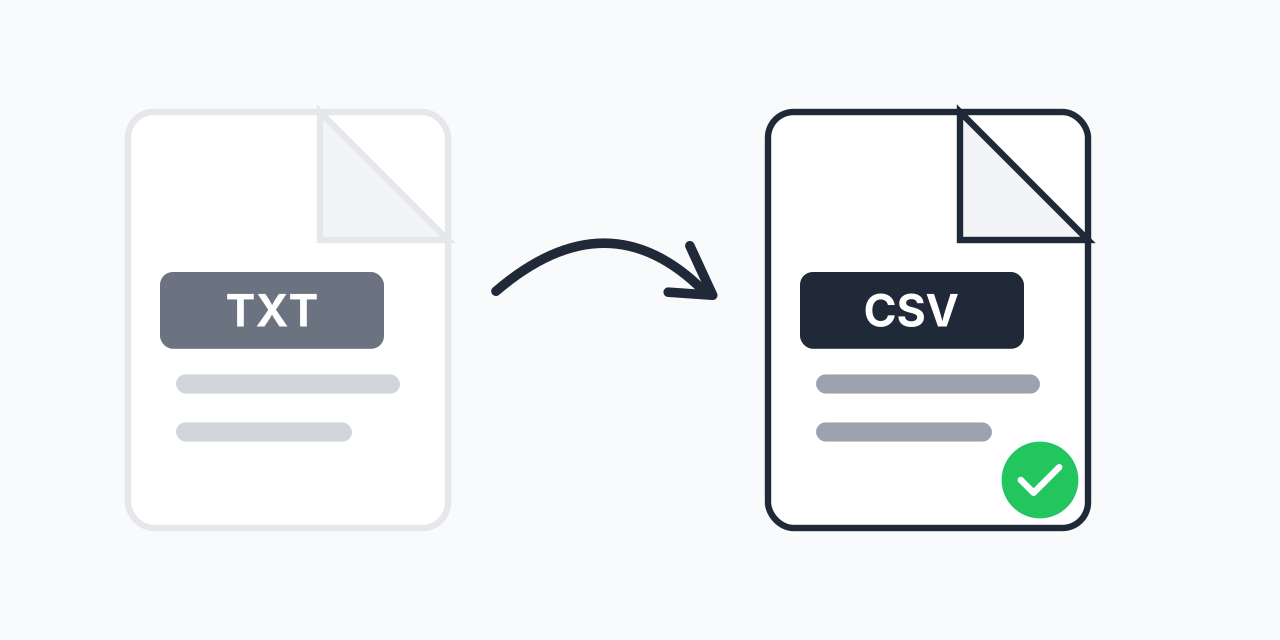
Converting to CSV gives your data the standardized structure it needs. CSV (Comma-Separated Values) is the universal format for tabular data, recognized by virtually every spreadsheet application and database system. In our testing, CSV files imported cleanly into Excel, Google Sheets, and LibreOffice Calc without any formatting issues.
How to Convert TXT to CSV
- Upload your TXT file - Drag and drop or click to select your text file
- Confirm CSV output - CSV is selected as your target format
- Download your CSV - Your data is now structured and ready for import
The conversion happens instantly in your browser. No software installation, no account creation, no waiting.
Why TXT Files Need Conversion
TXT files are the simplest text format available. They store plain text without any formatting or structure. While this simplicity makes them universally readable, it creates problems when you need to work with the data:
- No defined columns - Spreadsheet software cannot automatically detect where one field ends and another begins
- Inconsistent delimiters - TXT files might use tabs, spaces, pipes, or semicolons to separate values
- No data type recognition - Applications cannot distinguish between text, numbers, and dates
- Import failures - Many database import tools reject plain TXT files
CSV solves these issues by using standardized comma separation and optional text qualifiers, making your data immediately usable in any spreadsheet or database application.
Common Use Cases
Importing Data into Spreadsheets
You exported data from a legacy system that only outputs TXT files. Converting to CSV lets you open it directly in Excel or Google Sheets with proper column separation. Each value lands in its own cell, ready for analysis.
Database Imports
Database administrators often receive data as TXT files from external sources. CSV format is the standard for bulk imports into MySQL, PostgreSQL, and other database systems. Convert once, import cleanly.
Log File Analysis
Server logs and application logs are typically stored as TXT files. Converting to CSV lets you analyze them in spreadsheet software, filter by columns, and create charts from the data.
Data Migration
Moving data between systems often involves format conversion. If you have TXT files from an old system, converting to CSV format makes them compatible with modern applications.
TXT vs CSV: Key Differences
Understanding the difference helps you know when conversion is necessary:
- Structure - TXT files have no defined structure. CSV files organize data into rows and columns with standardized comma separation.
- Delimiters - TXT files might use any character (or no delimiter at all). CSV files use commas by definition, with RFC 4180 establishing the standard in 2005.
- Application support - While any text editor can open TXT files, CSV files are specifically designed for spreadsheet and database applications.
- Data integrity - CSV format handles special characters and values containing commas by using quotation marks as text qualifiers.
For data that needs to be organized into rows and columns, CSV is simply the better choice.
What to Expect After Conversion
Your converted CSV file will maintain all the original text content from your TXT file, but organized into a proper tabular structure. The converter intelligently detects delimiters in your source file and maps them to comma separation in the output.
If your original TXT file used tab separation, those tabs become commas. If it used spaces, those are converted appropriately. The result is a clean CSV file that opens correctly in any spreadsheet application.
Works on Any Device
Convert TXT to CSV right in your browser:
- Windows, Mac, Linux, Chromebook
- Chrome, Firefox, Safari, Edge
- iPhone, iPad, Android devices
No software downloads required. Your files stay on your device throughout the conversion process.