Need to Share an Illustrator File?
You have an AI file from a designer, but you cannot open it. Adobe Illustrator costs hundreds of dollars, and you just need to view or share the image. Without Illustrator, the file is useless.
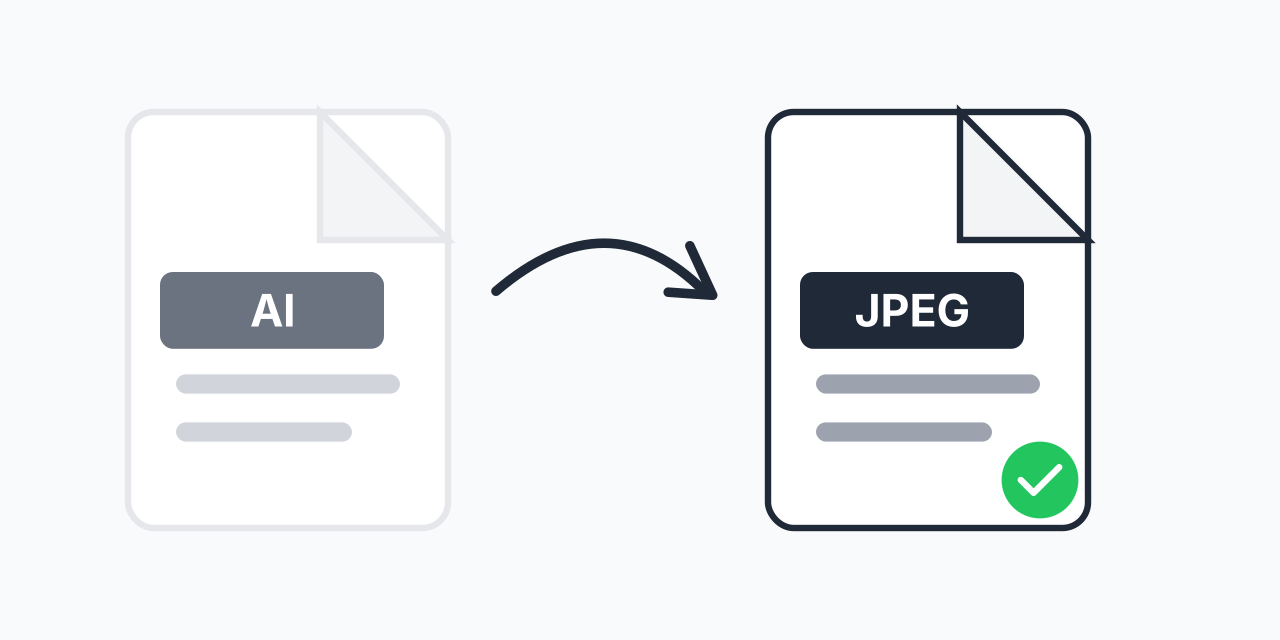
Converting AI to JPEG solves this instantly. JPEG is the universal image format that opens on every device, browser, and application. Your vector artwork becomes a shareable photo that anyone can view.
How to Convert AI to JPEG
- Upload your AI file - Select your Adobe Illustrator file
- Confirm JPEG output - JPEG is selected for maximum compatibility
- Download your image - Get a universally viewable image file
No Adobe subscription required. Convert in seconds directly in your browser.
Quality Considerations
Converting vector to raster is a one-way transformation. For best results:
- Export at the largest size you might need-you can scale down but not up
- Use high quality settings to minimize compression artifacts
- For graphics with text, consider PNG to keep edges sharp
- Always keep the original AI file for future edits
Our converter uses high-quality settings to preserve detail from your original artwork.
Understanding the Conversion
AI files are vector graphics-mathematical paths that scale to any size without quality loss. JPEG is a raster format made of pixels at a fixed resolution. When converting:
- Resolution matters - Higher resolution means larger, more detailed output
- Scalability is lost - The JPEG cannot be enlarged without pixelation
- File size drops - AI files are often megabytes; JPEGs are typically kilobytes
- Compatibility gained - Everyone can open JPEG without special software
Keep your original AI file if you need to make edits or export at different sizes later.
When to Convert AI to JPEG
Sharing with Clients
Your client does not have Illustrator and cannot open the AI file. Send them a JPEG preview they can view immediately on any device.
Website and Social Media
Most platforms accept JPEG uploads but reject AI files. Convert your artwork to post it online or use it in web content.
Email Attachments
AI files can be large and may not display properly in email. JPEG creates smaller, universally viewable attachments.
Document Embedding
Word documents, PDFs, and presentations accept JPEG but not AI. Convert to embed your graphics in documents.
JPEG vs PNG for Illustrator Files
Both formats work for rasterizing AI files, but they suit different needs:
- Choose JPEG when: Photos, complex gradients, web images where file size matters
- Choose PNG when: Logos with text, graphics needing transparency, sharp edges
JPEG compression can blur fine details like small text. For logos and graphics with crisp lines, consider PNG format instead.
Batch Convert Multiple AI Files
Have a folder of Illustrator files that need converting? Upload them all and convert to JPEG in one batch. Perfect for converting design assets or preparing files for a presentation.
Works on Any Device
Convert AI to JPEG right in your browser:
- Windows, Mac, Linux, Chromebook
- Chrome, Firefox, Safari, Edge
- iPhone, iPad, Android
No Adobe software needed. No downloads or installations required.