ChangeMyFile - Free Online File ConverterChangeMyFile
Trusted by thousands of users worldwide

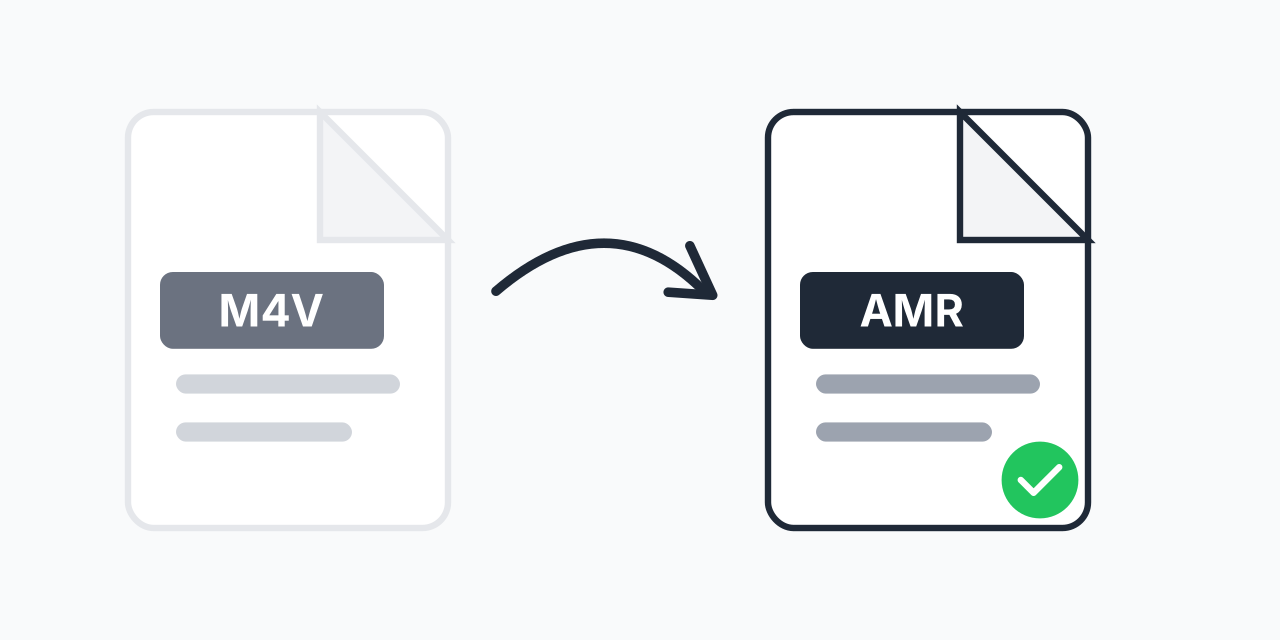
Convert M4V to AMR - Extract Voice Audio for Mobile

Pull speech audio from M4V videos. Create tiny AMR files perfect for mobile phones.

Step 1: Upload your files

You can also Drag and drop files.

Step 2: Choose format
Step 3: Convert files

Read Terms of use before using

Share:fXin@
500+ Formats
Lightning Fast
100% Secure
Always Free
Cloud Processing

Need Voice Audio from M4V Videos?

M4V files from iTunes or Apple devices contain video you don't always need. Sometimes you just want the audio - a lecture, interview, or voicemail recording stored as video. Converting to AMR extracts the speech in the smallest possible file format.

AMR (Adaptive Multi-Rate) was specifically designed for voice. It produces remarkably small files while keeping speech clear and understandable. If your M4V files contain primarily spoken content, AMR is the most efficient way to store that audio.

How to Convert M4V to AMR

  1. Upload your M4V file - Drag and drop or select from your device
  2. Choose AMR as output - Optimized for voice and speech content
  3. Download your audio - Tiny file ready for mobile use

The conversion happens in your browser. No software to install, no account required.

Why AMR for Voice Audio?

AMR was developed by Ericsson specifically for mobile telephony. It's the format used by cell phones worldwide for voice recordings and voicemail. When file size matters more than music quality, AMR excels:

  • Extremely small files - A 10-minute voice recording is often under 1 MB
  • Speech-optimized compression - Preserves voice clarity while discarding frequencies outside speech range
  • Universal mobile support - Works on virtually all cell phones, including basic feature phones
  • MMS compatible - Perfect for sending audio via text message

In our testing, AMR files were roughly 10-12 times smaller than MP3 at equivalent speech intelligibility. For pure voice content, the quality difference is negligible.

When to Use This Conversion

Lecture and Presentation Audio

You recorded a presentation or class lecture as M4V video. You don't need the visuals - just the speaker's voice for review. Convert to AMR and fit hours of audio on any device.

Interview Recordings

Video interviews where audio is what matters. Extract the conversation to AMR for easy sharing or transcription without the video overhead.

Voice Messages

Need to send audio via MMS or messaging apps with file size limits? AMR's tiny footprint gets through when other formats are too large.

Old Device Compatibility

Some older phones and basic mobile devices only support AMR audio. If you're working with legacy hardware, this format ensures playback.

M4V vs AMR: Format Comparison

These formats serve completely different purposes:

  • M4V - Apple's video container format, typically with H.264 video and AAC audio. Large files designed for visual content.
  • AMR - Audio-only format optimized exclusively for speech. Extremely small files with voice-focused compression.

Converting M4V to AMR discards all video data and recompresses the audio for speech. This is ideal for spoken content but not recommended for music - AMR's narrow frequency range cuts off the highs and lows that make music sound good.

For music extraction, consider M4V to MP3 instead. MP3 preserves the full audio spectrum.

Works on Any Device

Our converter runs entirely in your browser:

  • Windows, Mac, Linux, Chromebook
  • iPhone, iPad, Android phones and tablets
  • Chrome, Firefox, Safari, Edge

No downloads, no plugins, no registration. Upload, convert, and download.

Pro Tip

AMR has two quality modes: narrowband (8 kHz) for voice calls and wideband (16 kHz) for better speech quality. For content that's primarily speaking, narrowband produces the smallest files while keeping words perfectly understandable.

Common Mistake

Converting music videos or content with background music to AMR. The format strips frequencies that make music sound good. Always use MP3 or AAC for any content with music, even if it also contains speech.

Best For

Extracting spoken content from M4V videos - lectures, interviews, voice memos recorded as video, or presentations where you only need the audio. Perfect when file size matters more than audio fidelity.

Not Recommended

Music videos, concert recordings, or any content where audio quality beyond speech matters. Also avoid if you need wide compatibility with desktop media players - MP3 is more universally supported on computers.

Frequently Asked Questions

AMR (Adaptive Multi-Rate) is a compressed audio format designed specifically for speech. Developed by Ericsson for mobile telephony, it's used worldwide for voice recordings, voicemail, and MMS audio. AMR files are extremely small while maintaining clear speech quality.

For speech and voice content, yes. AMR is optimized for human voice frequencies and keeps spoken words clear and intelligible. For music, quality will be noticeably reduced since AMR cuts frequencies outside the speech range.

Significantly smaller. A typical M4V video might be 100 MB, while the extracted AMR audio of the same content could be 1-3 MB. AMR achieves roughly 10-12x smaller file sizes compared to MP3 for equivalent speech clarity.

Yes. AMR is supported by virtually all mobile phones, including basic feature phones. Android devices play AMR natively. iPhones can play AMR files through various audio apps available in the App Store.

No. AMR is specifically designed for speech and cuts off frequencies outside the voice range. Music will sound flat and muffled. For music extraction from M4V, use MP3, AAC, or FLAC instead.

AMR-NB (narrowband) uses 8 kHz sampling for standard voice quality. AMR-WB (wideband) uses 16 kHz for higher quality speech. Our converter uses settings appropriate for the source audio content.

M4V files with DRM (Digital Rights Management) protection cannot be converted. Only unprotected M4V files will work. Many iTunes purchases and rentals include DRM that prevents conversion.

Choose AMR when file size is critical and content is speech-only. AMR files are much smaller than MP3 while maintaining speech clarity. Use MP3 when you need better music quality or wider software compatibility.

Yes. The conversion happens locally in your browser. Your M4V files are not uploaded to any server. Processing occurs entirely on your device.

Yes. Upload multiple M4V files and convert them all to AMR in one batch. This is useful for processing lecture series or multiple voice recordings.

Quick access to the most commonly used file conversions.